Why Drug Treatment in Tennessee Matters More Than Ever
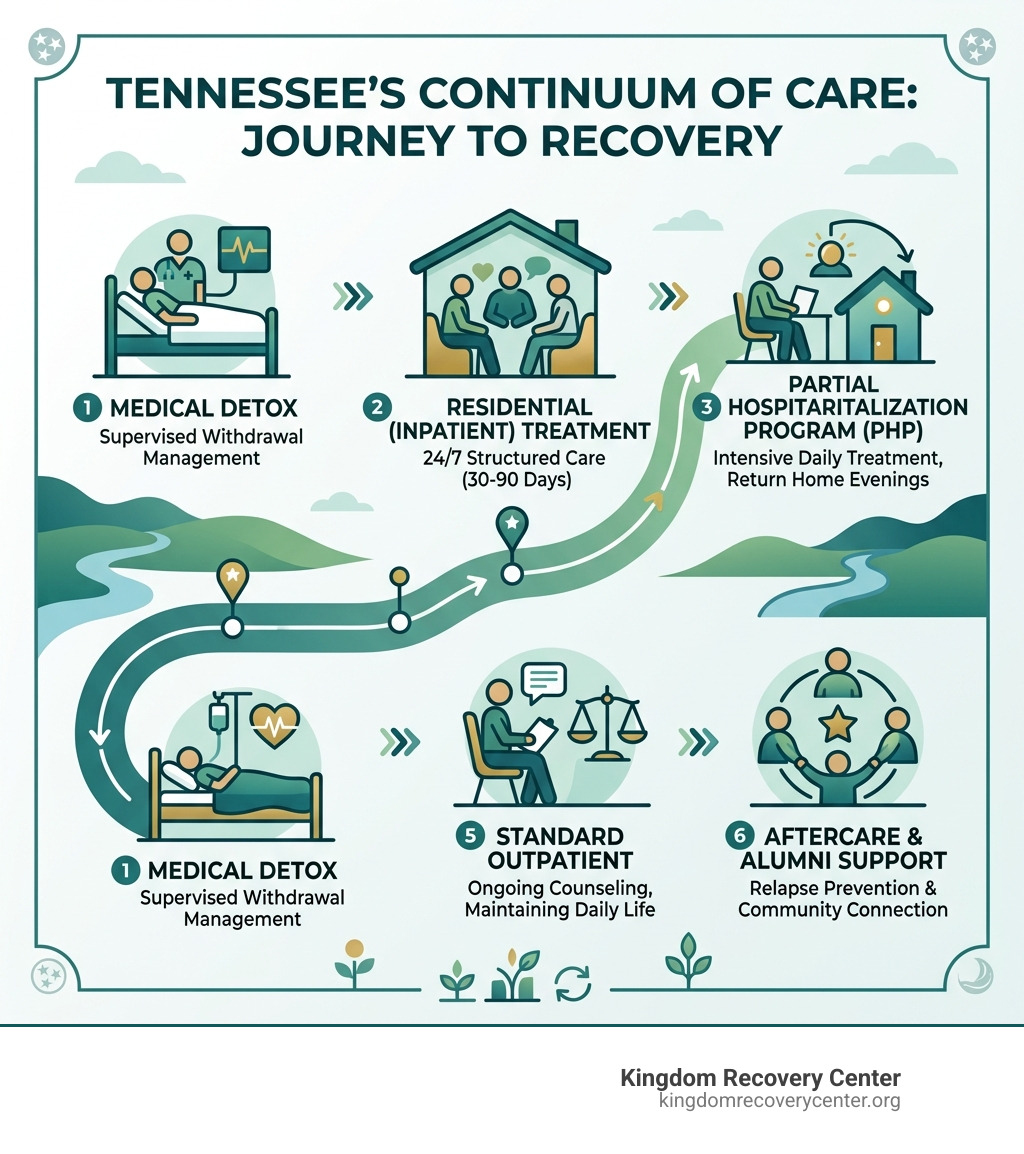
Drug treatment in Tennessee is available across a full spectrum of care — from medical detox and residential rehab to outpatient programs and long-term aftercare. Here is a quick overview of your main options:
- Medical Detox — Supervised withdrawal management, often the first step
- Residential (Inpatient) Treatment — 24/7 structured care, typically 30–90 days
- Partial Hospitalization Program (PHP) — Intensive daily treatment, return home evenings
- Intensive Outpatient Program (IOP) — 9–15 hours of therapy per week, flexible scheduling
- Standard Outpatient — Ongoing counseling while maintaining daily life
- Aftercare & Alumni Support — Relapse prevention and community connection post-treatment
Tennessee is in the middle of a serious substance use crisis. More than 14% of Tennesseans over age 12 have a substance use disorder — higher than the national average. Opioid overdose deaths top 3,000 per year in the state. Alcohol sends over 70,000 people to emergency rooms annually.
The good news? Recovery is absolutely possible. Nearly three in four adults who have struggled with substance use or mental health problems report being in recovery after treatment.
At Kingdom Recovery Center, based in Morristown, TN, we have spent years providing compassionate, evidence-based drug treatment in Tennessee to individuals facing addiction, mental health challenges, and co-occurring disorders. Our holistic, individualized approach meets people where they are — and helps them build a life worth staying sober for.
Simple guide to drug treatment in tennessee terms:
- inpatient alcohol rehab Tennessee
- residential dual diagnosis treatment centers near knoxville tn
- alcohol addiction treatment Tennessee
Understanding the Landscape of Drug Treatment in Tennessee

As we move through April 2026, the landscape of drug treatment in Tennessee has evolved to meet an increasingly complex set of challenges. Our state has been hit hard by the national opioid epidemic, with the Fentanyl Detox Tennessee needs skyrocketing over the last few years. Fentanyl has changed the game, making the “first step” of detox more dangerous and clinically demanding than ever before.
Beyond opioids, we are seeing significant Top 5 Meth Rehab Centers In Tennessee trends. Methamphetamine incidents have risen steadily, often involving high-purity batches that cause severe psychological distress. Alcohol use disorder also remains a primary reason for admission in East Tennessee, contributing to thousands of emergency room visits annually.
The Mental Health and Substance Abuse Services provided by the state highlight that addiction doesn’t happen in a vacuum. Whether you are seeking Drug Rehab East Tennessee or looking for help in more rural counties, the environment in which you recover matters.
| Feature | Urban Treatment (e.g., Knoxville) | Rural Treatment (e.g., Hamblen County) |
|---|---|---|
| Atmosphere | Fast-paced, close to transit/jobs | Serene, quiet, nature-focused |
| Accessibility | High; near major hospitals | Private; secluded for confidentiality |
| Amenities | Modern fitness centers, urban walks | Large acreage, outdoor activities |
| Community | Large, diverse recovery groups | Tight-knit, family-like support |
Common Substances Addressed in Tennessee Programs
In our facilities, we see a wide range of dependencies. While opioids and alcohol are the most frequent, many individuals seek help for What We Treat/Addictions involving benzodiazepines (like Xanax), cocaine, and prescription stimulants.
Because every substance affects the brain differently, our approach to What We Treat is never “one size fits all.” A person recovering from a long-term benzo habit requires a much different medical taper than someone coming off methamphetamine.
The Impact of Co-Occurring Disorders
It is a well-documented fact that approximately 50% of people with substance use disorders also have a “dual diagnosis”—a co-occurring mental health condition. This is why a comprehensive Mental Health Treatment Tennessee Guide is essential for anyone starting this journey.
Common co-occurring issues include:
- Generalized Anxiety Disorder
- Major Depressive Disorder
- Post-Traumatic Stress Disorder (PTSD)
- Bipolar Disorder
Using Effective Ways To Seek Mental Health Treatment In Tennessee involves finding a center that treats both the addiction and the underlying mental health issue simultaneously. If you only treat the drug use but leave the trauma or depression unaddressed, the risk of relapse remains high.
Levels of Care and Specialized Recovery Programs
Understanding the “levels of care” is vital when choosing drug treatment in Tennessee. Think of it as a ladder: some people need to start on the bottom rung with medical detox, while others might enter at a middle rung like outpatient care.
- Medical Detox: This is the Vital Aspects Of Selecting Drug And Alcohol Detox In Tennessee that many overlook. Detox is about safety. For substances like alcohol and benzos, withdrawal can be life-threatening. Medical supervision ensures you get through the physical “crash” comfortably.
- Residential Treatment: Often called “inpatient,” this is where you live at the facility. If you are looking for Inpatient Rehab Hamblen County Tn, you’ll find that 24/7 care provides the structure necessary to break old habits.
- Partial Hospitalization (PHP): This is a “step-down” level. You spend 5–6 hours a day in therapy but may return home or to a sober living environment in the evenings.
- Intensive Outpatient (IOP): For those who need to maintain work or school, IOP offers 9–15 hours of weekly therapy. We believe The Best Inpatient Drug Treatment Options In Tennessee should always include a clear path into an IOP to ensure long-term success.
Holistic and Unique Drug Treatment in Tennessee Approaches
Recovery isn’t just about sitting in a circle and talking. Modern Holistic Approaches To Addiction Recovery In Tennessee Explained involve treating the whole person—mind, body, and spirit.
In Tennessee, we are uniquely positioned to offer therapies that utilize our natural landscape and cultural heritage:
- Equine Therapy: Working with horses helps build trust, emotional regulation, and non-verbal communication skills.
- Music Therapy: Given our proximity to Nashville and Knoxville’s rich music scenes, many programs use songwriting and expression as a healing tool.
- Christian-Based Programs: For those who want their faith to be the cornerstone of their recovery, specialized “ReNew” or Christian-immersion tracks are widely available.
- 12-Step Immersion: Many centers still rely on the time-tested principles of AA and NA, helping clients build a spiritual foundation.
- Mindfulness & Yoga: These tools help “steady the mind,” which is crucial during the early, high-anxiety days of sobriety.
Specialized Support for Dual Diagnosis Patients
If you are struggling with both addiction and a mental health disorder, you need an integrated team. This includes psychiatrists, licensed clinical social workers, and addiction specialists who talk to each other daily. Finding Your Guide To Finding The Right Mental Health Treatment In Tennessee means looking for facilities that utilize Cognitive Behavioral Therapy (CBT) and Dialectical Behavior Therapy (DBT). These evidence-based methods help you “re-wire” the thought patterns that lead to substance use.
For those in the Morristown area, finding Alcohol & Drug Rehabs in Morristown, Tennessee that offer these dual-diagnosis tracks is the gold standard for care.
Navigating Insurance and State-Funded Support
One of the biggest hurdles to getting drug treatment in Tennessee is the “how do I pay for it?” question. The good news is that most private insurance plans are now required by law to cover addiction and mental health services.
When searching for the Top Tn Inpatient Drug Rehabs Covered By Insurance, look for centers that are Joint Commission accredited. This “Gold Seal” means the facility meets the highest national standards for safety and quality. Most major PPO plans (BlueCross BlueShield, Aetna, Cigna, etc.) offer significant coverage for detox, residential, and outpatient services.
If you don’t have insurance, don’t lose hope. There are several The Best Rehabs In Tennessee On A Budget that offer sliding scale fees or work with state grants.
State-Funded Programs for Eligible Individuals
Tennessee offers specific funding for individuals who meet certain criteria, particularly those involved in the criminal justice system or those living below the poverty line.
- ADAT (Alcohol and Drug Addiction Treatment): Specifically for those convicted of a DUI who cannot afford treatment.
- SPOT (Supervised Probation Offender Treatment): Aimed at individuals on probation who are at risk of violation due to substance use.
- Community Treatment Collaborative: This program helps those on state probation or parole who have a substance use or co-occurring diagnosis.
To qualify for many of these, an individual must typically meet the 133% Federal Poverty Guidelines. If you are searching for alcohol and drug rehab centers in or near Johnson City, TN, these state-funded options can be a literal lifesaver.
Steps to Verify Coverage and Admissions
Getting started is often the hardest part, but we try to make it as seamless as possible. Most reputable centers offer a free assessment to determine exactly what level of care you need.
The general treatment process looks like this:
- Initial Call: A confidential conversation about your history and needs.
- Insurance Verification: The center contacts your provider to see what is covered (often $0 out-of-pocket for many clients).
- Clinical Intake: A deeper dive with a professional to create your individualized plan.
- Admission: Scheduling your arrival. Many Drug & Alcohol Rehab in Knoxville, TN locations even help with travel coordination.
Long-Term Success and Aftercare in Tennessee
Completing a 30-day program is a huge achievement, but the real work begins when you return to your daily life. This is why The Importance Of Rehab Programs In Tennessee For Lasting Recovery cannot be overstated. Without a plan for “after,” the risk of relapse is high.
A solid aftercare plan usually includes:
- Alumni Networks: Staying connected to the people you went through treatment with.
- Transitional Housing: “Sober living” homes that provide a drug-free environment while you get back on your feet.
- Recovery Coaching: One-on-one mentorship to navigate the stresses of early sobriety.
- Family Therapy: Healing the relationships that may have been damaged during active addiction.
If you are in Drug Rehab Hamblen County Tn, look for programs that offer local support groups and long-term follow-up.
Finding Local Drug Treatment in Tennessee Resources
Whether you are in the heart of Nashville or the mountains of East Tennessee, help is nearby.
- Knoxville: Home to numerous outpatient and detox facilities. If you need More info about alcohol detox services, the Knoxville area is a major hub for medical care.
- Morristown & Hamblen County: Offers a mix of residential and outpatient care with a “small-town” support feel.
- Johnson City: Provides excellent resources for those in the Tri-Cities area.
While urban centers have more facilities, rural accessibility has improved significantly through telehealth services, allowing those in remote areas to attend group therapy and individual counseling from home.
Frequently Asked Questions about Tennessee Rehab
What are the most common types of substance addictions treated in Tennessee?
The most common addictions treated in Tennessee centers are opioids (including fentanyl and prescription painkillers), alcohol, methamphetamine, and benzodiazepines. We also see a significant number of individuals seeking help for polydrug use—where multiple substances are being used simultaneously.
How does insurance coverage work for addiction treatment in Tennessee?
Most private health insurance plans cover addiction treatment as an “essential health benefit.” This includes detox, residential care, and outpatient services. Many Tennessee facilities are “in-network” with major providers like BlueCross BlueShield of Tennessee, which can significantly lower out-of-pocket costs. Free insurance verification is typically offered by the admissions team at most centers.
What specialized programs exist for co-occurring mental health disorders?
Specialized “Dual Diagnosis” programs are designed for this exact purpose. These programs integrate psychiatric care with addiction counseling. They utilize therapies like Cognitive Behavioral Therapy (CBT) and Dialectical Behavior Therapy (DBT) to treat conditions like depression, anxiety, and PTSD alongside the substance use disorder.
Conclusion
As we look toward the remainder of 2026, the message for anyone seeking drug treatment in Tennessee is clear: you do not have to do this alone. From the clinical excellence of our medical detox programs to the restorative power of our holistic therapies, Tennessee offers some of the best recovery options in the country.
At Kingdom Recovery Center, we remain dedicated to providing client-centered, evidence-based care that honors the unique story of every individual who walks through our doors. Whether you are in Morristown, Knoxville, or Johnson City, our team is ready to help you rediscover a fulfilling, substance-free life.
Recovery isn’t just about quitting drugs; it’s about starting a new life. With the right support, compassionate care, and a personalized plan, lifelong sobriety is within your reach. Take that first step today—your future self will thank you.