Opioid Addiction Recovery: What You Need to Know
Opioid addiction recovery is possible — and it starts with understanding your options.
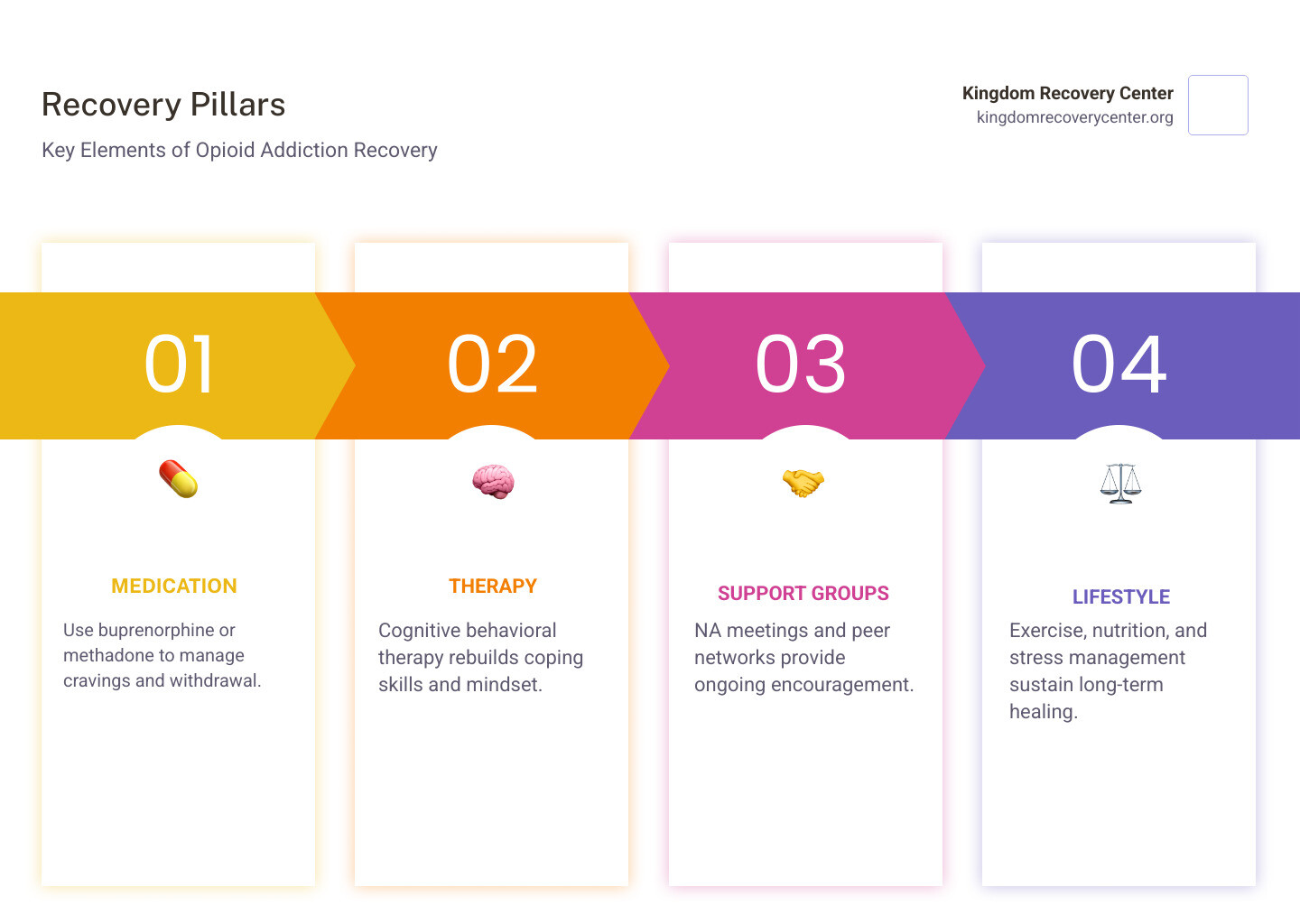
Here is a quick overview of the main treatment approaches:
| Treatment Type | What It Does |
|---|---|
| Medication (MAT) | Reduces cravings and withdrawal using methadone, buprenorphine, or naltrexone |
| Behavioral Therapy | Builds coping skills and addresses root causes through CBT, DBT, and counseling |
| Medical Detox | Safely manages withdrawal symptoms under clinical supervision |
| Peer & Community Support | Provides accountability and connection through groups like NA or SMART Recovery |
| Dual Diagnosis Treatment | Treats addiction alongside co-occurring mental health conditions like anxiety or trauma |
The best outcomes come from combining these approaches in a personalized plan — not relying on any single method alone.
Opioid use disorder (OUD) is one of the most serious public health crises in the United States. From 1999 to 2020, more than 800,000 Americans died from drug overdoses — a number that has contributed to a measurable decline in U.S. life expectancy. OUD is classified as a chronic, relapsing brain disease, meaning it is not a moral failing or a lack of willpower. Like diabetes or heart disease, it has recognized symptoms, a pattern of progression, and — critically — effective treatments.
If you or someone you love is struggling in Tennessee, you are not alone, and help is available.
At Kingdom Recovery Center in Morristown, TN, we specialize in compassionate, evidence-based opioid addiction recovery using individualized treatment plans that address both the physical and emotional sides of healing. Our experienced team is here to guide you from detox through long-term recovery and beyond.

Understanding Opioid Use Disorder as a Chronic Disease
When we talk about opioid addiction recovery, we first have to understand what we are fighting. Opioid Use Disorder (OUD) isn’t just a “bad habit.” It is a complex illness characterized by a compulsive drive to use opioids even when the person wants to stop or when the use causes physical and emotional harm.
The Impact on Brain Chemistry
Opioids work by binding to specific receptors in the brain, triggering a massive release of dopamine. This neurotransmitter is responsible for feelings of pleasure and reward. Over time, the brain becomes “hijacked.” It stops producing its own feel-good chemicals and starts relying on the drug just to feel “normal.” This shift in brain chemistry is why willpower alone usually isn’t enough to stop.
Physical Dependence vs. Addiction
It is important to distinguish between the two. A person can be physically dependent on a medication—meaning they experience withdrawal symptoms if they stop—without being addicted. For example, a cancer patient in East Tennessee taking prescribed pain relief may be dependent. Addiction, or OUD, involves the behavioral aspect: the inability to control use, cravings, and continued use despite negative consequences in work, health, or relationships.
Scientific research shows that medications for opioid use disorder are the gold standard for treating this chronic disease because they help stabilize this broken brain chemistry. You can find more info about opioid treatment options to see how these medical insights translate into real-world care.
The Clinical Path to Opioid Addiction Recovery
The journey usually begins with a decision to seek help, followed by a clinical assessment. Because everyone’s history with opioids is different, we believe treatment must be individualized.

Medical Detoxification: The First Step
For many, the fear of withdrawal is the biggest barrier to starting opioid addiction recovery. Medical detox provides a safe, supervised environment where clinicians use medications to ease the discomfort of withdrawal. We cannot stress this enough: “cold turkey” is not only painful but carries a high risk of immediate relapse.
Choosing a medically assisted detox ensures a smoother transition into the next phases of care. By understanding drug and alcohol detox withdrawal symptoms, patients and families can prepare for the physical challenges of the first few days.
Comparing Common Medications
In Tennessee, several FDA-approved medications are used to support long-term sobriety. Here is how they compare:
| Medication | Type | How it Works | Setting |
|---|---|---|---|
| Methadone | Full Agonist | Activates receptors to stop withdrawal/cravings without the “high.” | Certified Clinics (OTPs) |
| Buprenorphine | Partial Agonist | Partially activates receptors; has a “ceiling effect” to prevent misuse. | Office-based/Clinics |
| Naltrexone | Antagonist | Blocks receptors so opioids have no effect; prevents the “high.” | Any Provider |
Medication-Assisted Treatment (MAT) for Opioid Addiction Recovery
MAT is the use of medications in combination with counseling and behavioral therapies. It is not “trading one addiction for another.” Instead, it is using medicine to manage a chronic illness, much like using insulin for diabetes.
- Buprenorphine: Often found in brands like Suboxone (which includes naloxone to prevent misuse), this is a popular choice because it can be prescribed by qualified clinicians in an office setting, offering more flexibility for those in Hamblen County or Knoxville.
- Methadone: This has been used for decades and is highly effective for those with severe, long-term OUD. It requires daily visits to a certified program initially, providing a high level of structure.
- Naltrexone: Unlike the others, you must be completely opioid-free for 7–10 days before starting this. It is excellent for those who have completed detox and want an extra layer of protection against relapse.
For more detailed guidance, you can review the information about FDA-approved medications for OUD from federal health authorities.
Behavioral Therapies and Counseling
While medications fix the chemistry, therapy fixes the “why.” Behavioral health is the cornerstone of lasting change. At Kingdom Recovery Center, we utilize several evidence-based modalities:
- Cognitive Behavioral Therapy (CBT): This helps patients identify and change the thought patterns that lead to drug use. If you can change the thought, you can change the action.
- Dialectical Behavior Therapy (DBT): This is particularly useful for managing intense emotions and improving relationships, which are often strained during active addiction.
- Group Therapy: There is immense power in knowing you aren’t the only one. Group sessions provide a community of peers who understand the unique struggles of recovery in Tennessee.
Learning these skills is vital for the long haul. We provide key insights on relapse prevention to help our clients navigate high-risk situations once they leave our structured environment.
Navigating Opioid Withdrawal and Brain Healing
Withdrawal is the body’s way of recalibrating to the absence of opioids. While it is rarely life-threatening (unlike alcohol withdrawal), it is incredibly uncomfortable.
The Withdrawal Timeline
Symptoms typically begin within 6–12 hours for short-acting opioids (like heroin or oxycodone) and 30 hours for long-acting ones (like methadone).
- The Peak: Symptoms usually peak around 72 hours. This is the “flu-from-hell” stage, involving muscle aches, sweating, nausea, and intense anxiety.
- The Easing: After the first week, physical symptoms begin to fade, but psychological symptoms may persist.
For a deeper dive into what to expect, check out our insights on substance detox timelines.
The Timeline of Brain Recovery in Opioid Addiction Recovery
Healing the brain takes time. It doesn’t happen the moment the drugs leave your system.
- Early Recovery (0-6 months): The brain is in a state of shock. Cravings are high, and emotions like anxiety and depression are common as the dopamine system tries to restart.
- Mid-term Recalibration (6-12 months): Cravings become less frequent. Mental clarity begins to return, and the brain’s reward system starts to respond to natural pleasures again—like a good meal or a sunset over the Tennessee mountains.
- Long-term Restoration (2+ years): Research suggests that after two years of sustained opioid addiction recovery, cognitive function can return to near pre-addiction levels. Emotional stability becomes the “new normal.”
Addressing Co-Occurring Disorders and Fentanyl Risks
Many people struggling with opioids are also dealing with untreated mental health issues like depression, PTSD, or anxiety. This is known as a Dual Diagnosis. If we only treat the addiction and ignore the depression, the risk of relapse is incredibly high.
Furthermore, the rise of fentanyl has changed the landscape of recovery in East Tennessee. Fentanyl is 50 to 100 times more potent than morphine, making the window for overdose much smaller and the withdrawal often more intense. Recognizing the signs of fentanyl addiction is the first step in saving a life. We offer specialized dual diagnosis treatment programs in TN to ensure every aspect of a patient’s health is addressed.
Overdose Prevention and Long-Term Support Systems
Recovery doesn’t happen in a vacuum. It requires a safety net and a community.
Naloxone (Narcan): The Life-Saver
Every family in Tennessee affected by OUD should have Naloxone (Narcan) on hand. Naloxone is a medication that can instantly reverse an opioid overdose by “knocking” the opioids off the brain’s receptors. It is non-addictive and easy to use. While it isn’t a treatment for addiction, it keeps people alive long enough to get to treatment.
Reducing Stigma and Building Support
Stigma is a silent killer. When people feel ashamed, they hide their use and avoid seeking help. By recognizing OUD as a medical condition, we can break down those barriers.
Long-term success often involves “mutual aid” groups. These provide ongoing accountability:
- Narcotics Anonymous (NA): A traditional 12-step program focused on spiritual growth and peer support.
- SMART Recovery: A science-based alternative that focuses on self-empowerment and cognitive tools.
For those with complex needs, integrated recovery for dual diagnosis provides the most comprehensive path forward.
Frequently Asked Questions about Opioid Recovery
Is opioid addiction considered a disease?
Yes. Major medical organizations, including the American Society of Addiction Medicine (ASAM), classify it as a chronic brain disease. It changes the structure and function of the brain, leading to behaviors that are often beyond a person’s conscious control without professional help.
How does naloxone work during an overdose?
Think of naloxone like a “bouncer” at a club. The opioids are the “unruly guests” sitting on the brain’s receptors (the seats). Naloxone rushes in, kicks the opioids off the seats, and sits there itself for a short time, allowing the person to start breathing again. However, it wears off in 30–90 minutes, so emergency medical help is still required immediately.
What is the difference between buprenorphine and methadone?
Both stop withdrawal and cravings. Methadone is a “full agonist,” meaning it fully activates the receptors; it’s very strong and usually dispensed in liquid form at specialized clinics. Buprenorphine is a “partial agonist,” meaning it only partially activates the receptors. It has a “ceiling effect,” making it harder to overdose on and allowing it to be prescribed in more traditional doctor’s offices.
Conclusion
Opioid addiction recovery is a marathon, not a sprint. It requires patience, the right medical tools, and a support system that refuses to give up on you.
At Kingdom Recovery Center, we are proud to serve the communities of Morristown, Knoxville, and Johnson City. We offer client-centered, evidence-based care that focuses on the individual, not just the diagnosis. Whether you are looking for medical detox, dual diagnosis support, or long-term outpatient therapy, our team is dedicated to empowering lasting change.
You don’t have to wait for a “rock bottom” or a crisis to reach out. The best time to start your journey is right now. Start your journey to recovery today and find your way back to the life you deserve.