Knoxville, TN Has a Serious Addiction Problem — Here’souse What You Need to Know
Rehab Knoxville TN is one of the most searched recovery topics in East Tennessee — and for good reason. Thousands of Knox County residents are struggling with addiction right now, and finding the right help can feel overwhelming.
Here is a quick overview of what rehab in Knoxville looks like:
| What You Need | What’s Available in Knoxville |
|---|---|
| Detox | 9 detox centers |
| Inpatient/Residential | 5 inpatient rehab centers |
| Outpatient (IOP/PHP) | 29 outpatient programs |
| Free/Low-cost options | 15 free treatment programs |
| Dual diagnosis care | Multiple facilities treating addiction + mental health |
| Medication-assisted treatment | Suboxone, methadone, and naltrexone available |
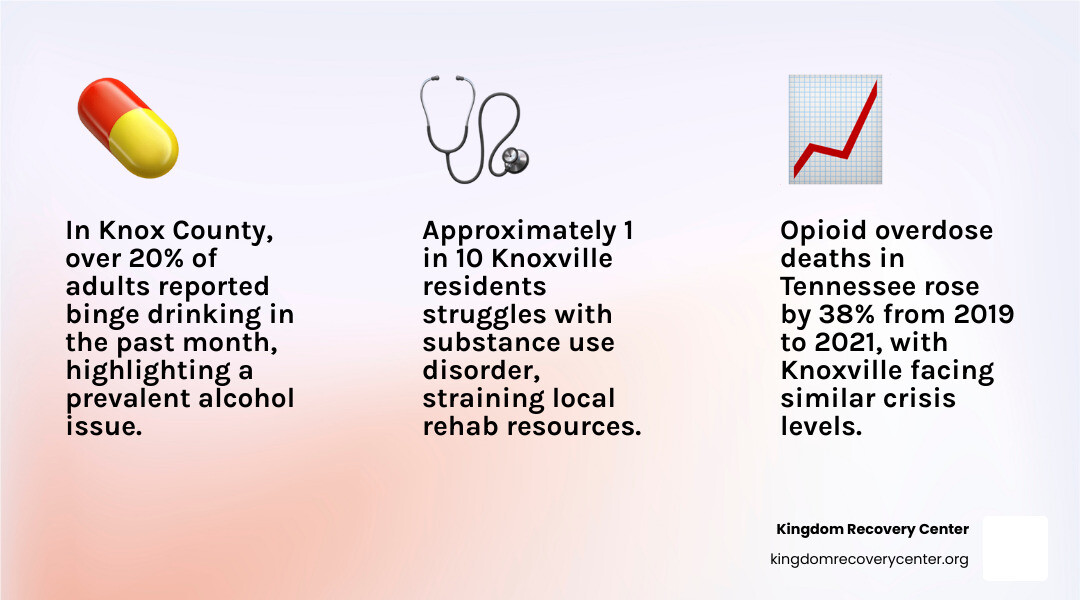
The scale of the problem is significant. Roughly 20,279 people in the Knoxville area have used state-funded substance use services. There were approximately 1,333 non-fatal overdoses and 342 fatal overdoses recorded locally. Opioids and alcohol together account for nearly 80% of all rehab admissions in the area.
The good news? Effective treatment exists, and recovery is genuinely possible — regardless of how long someone has been struggling.
At Kingdom Recovery Center, based in Morristown, TN, we bring compassionate, evidence-based addiction and mental health treatment to people across East Tennessee, including those searching for rehab Knoxville TN and surrounding communities. Our holistic, individualized approach covers everything from detox to aftercare, and we are here to walk with you every step of the way.
Comprehensive Treatment Programs for Rehab in Knoxville TN
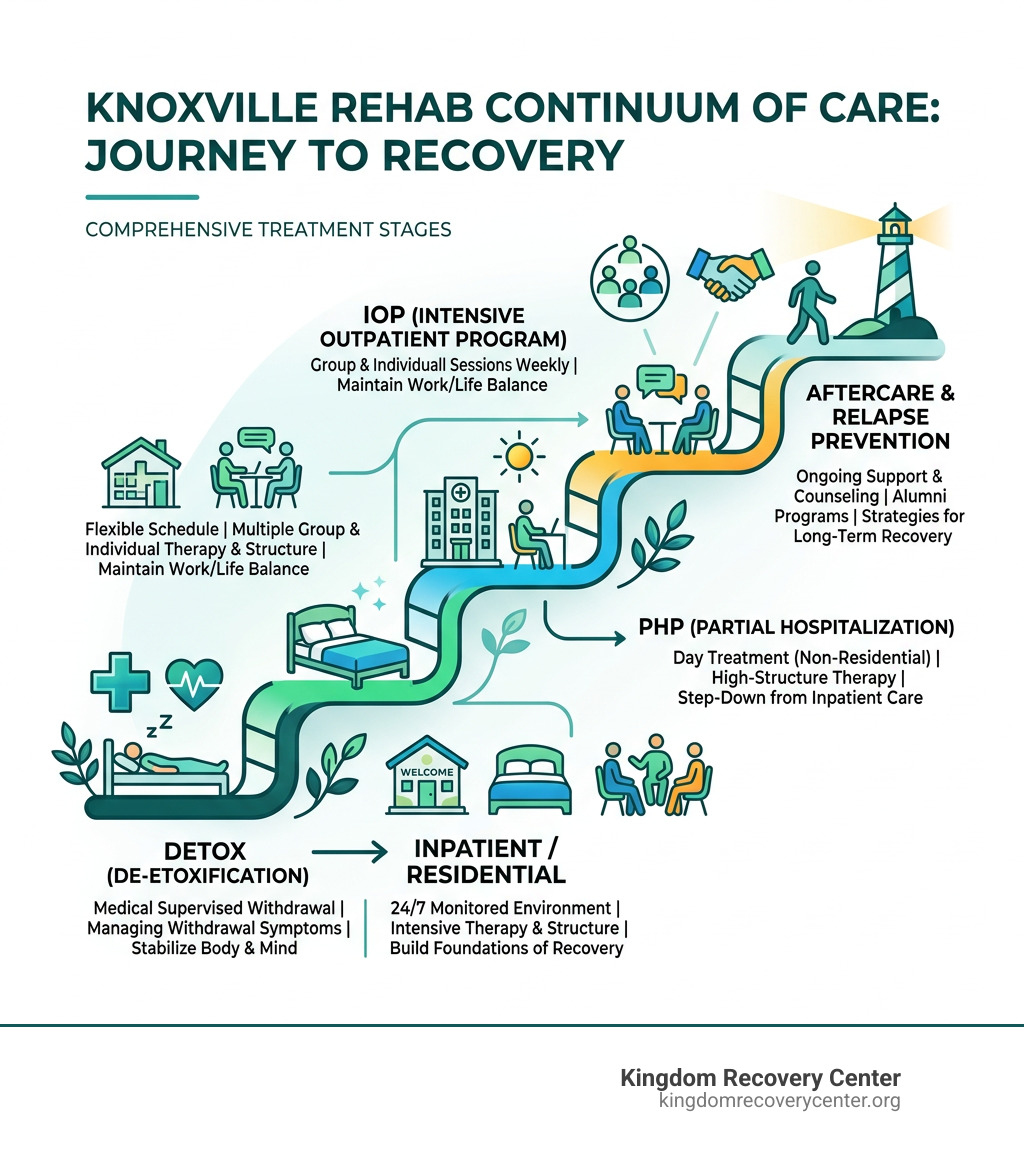
When you start looking for rehab knoxville tn, you’ll quickly realize that “rehab” isn’t just one thing. It is a spectrum of care designed to meet people exactly where they are. Think of it like a ladder: some people need to start on the bottom rung with intensive medical supervision, while others might be higher up, needing only weekly support to stay on track.
Scientific research consistently shows that longer engagement in treatment leads to better outcomes. In fact, many experts now argue that traditional 28-day programs are often too short. The brain needs time to heal from the chemical changes caused by substance use, and a comprehensive continuum of care provides that time.
Medical Detox
For many, the first step is detoxification. This is the process of clearing substances from the body. In Knoxville, there are approximately 9 dedicated detox centers. Medical detox is crucial because withdrawing from certain substances, like alcohol or benzodiazepines, can be physically dangerous or even fatal without professional supervision.
Partial Hospitalization Program (PHP)
A PHP is often described as the “middle ground.” It offers a high level of structure — typically five to seven days a week for several hours a day — but allows the individual to return home or to a sober living environment in the evening. This is an excellent option for those who need intensive therapy but have a stable living situation.
Intensive Outpatient Program (IOP)
IOPs are more flexible, usually meeting three to four times a week. This allows residents in Knoxville to maintain work, school, or family commitments while still receiving evidence-based therapy. Many programs even offer evening sessions to accommodate professional schedules.

If you are interested in learning more about high-level care, you can find more info about inpatient services to see if a residential stay is the right fit for your journey.
Comparing Inpatient and Outpatient Rehab in Knoxville TN
Choosing between inpatient and outpatient care is one of the biggest decisions you’ll make. Here’s how they stack up:
Inpatient/Residential Rehab:
- 24/7 Supervision: You live at the facility, which removes you from the triggers of your everyday environment.
- Structure: Every hour of your day is planned, from therapy sessions to wellness activities.
- Community: You are surrounded by peers who are going through the exact same struggle.
- Best For: Those with severe addictions, high relapse risk, or unstable home lives.
Outpatient Rehab:
- Flexibility: You can continue living at home and often keep your job.
- Telehealth Options: Many Knoxville providers now offer virtual therapy, making it easier for those in rural areas of East Tennessee to get help.
- Real-World Practice: You can immediately apply the coping skills you learn in therapy to your daily life.
- Best For: Those with mild-to-moderate addiction and a strong, supportive home environment.
For a deeper dive into these choices, check out our guide to Knoxville rehab.
Specialized Dual Diagnosis and Holistic Care
We believe that addiction rarely travels alone. Often, it brings “friends” like anxiety, depression, or PTSD. This is known as a dual diagnosis or co-occurring disorders. If you only treat the addiction and ignore the underlying mental health issue, the risk of relapse is incredibly high.
In Knoxville, top-tier facilities focus on integrated treatment. This means using evidence-based modalities like:
- Cognitive Behavioral Therapy (CBT): Helping you identify and change negative thought patterns.
- Dialectical Behavior Therapy (DBT): Teaching emotional regulation and distress tolerance.
- EMDR (Eye Movement Desensitization and Reprocessing): A specialized therapy used to process and heal from trauma.
Beyond the clinical side, holistic care is gaining massive traction in East Tennessee. We’ve found that healing the “whole person” — mind, body, and spirit — is essential. This might include equine therapy, where working with horses helps build trust and emotional awareness, or yoga and meditation to help recalibrate the nervous system.
If mental health is a primary concern for you, explore the top anxiety treatment in Knoxville to see how specialized care can make a difference.
Local Statistics and Substance Use Trends
Understanding the landscape of rehab knoxville tn requires looking at the hard data. Knoxville and the surrounding Knox County area have been hit hard by the national addiction crisis, but the community is fighting back with increased resources.
Recent data shows that over 20,000 residents in the region have accessed state-funded recovery services. According to the Substance Abuse and Mental Health Services Administration (SAMHSA), early intervention and access to treatment are critical for reducing overdose rates. The demographics show that the most common age range for those seeking treatment is 25 to 29 years old. However, overdose deaths are most prevalent among males aged 35 to 44, highlighting a critical need for early intervention.
The substances driving these numbers are primarily opioids and alcohol. Interestingly, while fentanyl dominates the headlines due to its lethality, alcohol remains a massive factor in local rehab admissions.
Substance Admission Percentages in Knoxville
| Substance | Percentage of Admissions |
|---|---|
| Opiates (other than Heroin) | 40% |
| Alcohol | 39% |
| Methamphetamine | 10% |
| Cocaine | 10% |
| Heroin | 10% |
Note: Percentages may overlap as many individuals seek treatment for multiple substances.
The rise of fentanyl has also led to a spike in non-fatal overdoses (over 1,300 annually in the area). This has prompted local health officials to focus heavily on harm reduction and immediate access to treatment.
Navigating Costs, Insurance, and Tennessee Laws
One of the most common questions we hear is, “How am I going to pay for this?” The cost of rehab knoxville tn varies wildly based on the level of care and the amenities provided. For example, a residential stay might average around $16,000 for a three-month program without insurance, whereas outpatient care is significantly more affordable.
Insurance Verification
Most private insurance plans cover addiction treatment to some extent. Under the Affordable Care Act, substance use disorder services are considered essential health benefits. In Knoxville, facilities often accept:
- Blue Cross Blue Shield
- United Healthcare
- Aetna
- TRICARE (for veterans and military families)
- TennCare (Tennessee’s Medicaid program)
Verification is usually the first step in the admissions process. You can contact a facility, and they will run your benefits to tell you exactly what is covered and what your out-of-pocket costs might be. For more information on local facilities and their payment options, visit our page on rehab centers in Knoxville.
Tennessee Laws and Protections
Tennessee has several laws designed to save lives and encourage people to seek help:
- Good Samaritan Law: This law protects individuals from arrest or prosecution for certain drug-related offenses if they are seeking medical assistance for an overdose (either for themselves or someone else). You can find more details on these protections via the Tennessee Department of Health. You should never hesitate to call 911.
- Naloxone Access: In Tennessee, you can get Naloxone (Narcan) over-the-counter without a prescription. There are even free online training sessions available to help you learn how to use it.
- DUI Laws: For those facing legal trouble, Tennessee courts often allow (or mandate) rehab for first-time DUI offenders as part of a recovery-focused sentencing structure.
Medication-Assisted Treatment (MAT) for Rehab in Knoxville TN
For many struggling with opioid or alcohol dependency, “willpower” isn’t enough to overcome the physical cravings. Medication-Assisted Treatment (MAT) uses FDA-approved medications combined with counseling and behavioral therapy to provide a “whole-patient” approach.
Common medications used in Knoxville include:
- Suboxone (Buprenorphine/Naloxone): Helps manage withdrawal symptoms and cravings for opioids.
- Vivitrol (Naltrexone): An injectable medication that blocks the effects of opioids and reduces the desire to drink alcohol.
- Methadone: Used in highly structured clinics to treat opioid addiction.
MAT has been proven to increase treatment retention and decrease illicit opioid use. If you’re specifically looking for help with alcohol, you can find alcohol detox resources that incorporate these medical advancements.
Local Support Resources and Aftercare
Recovery doesn’t end when you leave a rehab facility; in many ways, that’s just where it begins. Knoxville has a vibrant and supportive recovery community.
- Support Groups: There are hundreds of weekly meetings for Alcoholics Anonymous (AA) and Narcotics Anonymous (NA) throughout Knox County. For those looking for a non-12-step approach, SMART Recovery is also available.
- Family Programs: Addiction is a family disease. Many local resources offer counseling and support groups for loved ones to help them understand the science of addiction and set healthy boundaries.
- Alumni Networks: Many people find that staying connected to the facility where they got sober helps them maintain long-term success.
For a comprehensive list of what’s available in the area, check out our local resources in Knoxville.
Frequently Asked Questions about Knoxville Rehab
How much does drug and alcohol rehab cost in Knoxville?
The price depends on the “level of care.” Inpatient treatment is the most expensive due to 24/7 staffing and housing. Outpatient programs are more budget-friendly. Most people use private insurance to cover the bulk of the cost. If you don’t have insurance, many Knoxville facilities offer sliding fee scales based on your income or payment plans to make treatment accessible.
Are there free or low-cost rehab options in Tennessee?
Yes. Knoxville has approximately 15 free or state-funded treatment programs. These are often managed through the Tennessee Department of Mental Health and Substance Abuse Services. Additionally, many facilities accept Medicaid (TennCare) and Medicare. Some hospital-based rehabilitation programs and state-funded providers may also offer specialized medical-focused services that can be covered by these programs.
How do I start the admissions process for rehab?
It usually starts with a simple phone call. You’ll go through a clinical assessment where a professional asks about your substance use history and mental health. Then, there is insurance verification to see what your plan covers. Finally, an intake evaluation is scheduled where you meet the team and begin your personalized treatment plan.
Conclusion
Finding the right rehab knoxville tn is about more than just “quitting” — it’s about building a life that you don’t feel the need to escape from. Whether you are looking for the intensive structure of a residential program or the flexibility of outpatient therapy, the resources in East Tennessee are ready to support you.
At Kingdom Recovery Center, we are dedicated to providing that support. Our evidence-based, client-centered approach is designed to empower lasting change. We serve Knoxville, Morristown, Johnson City, and the surrounding areas with a commitment to individualized care.
You don’t have to do this alone. If you’re ready to take that first step, start your recovery journey with us today. We are here to help you rediscover your strength and reclaim your life.