Understanding Mental Health Care Access in Grainger County
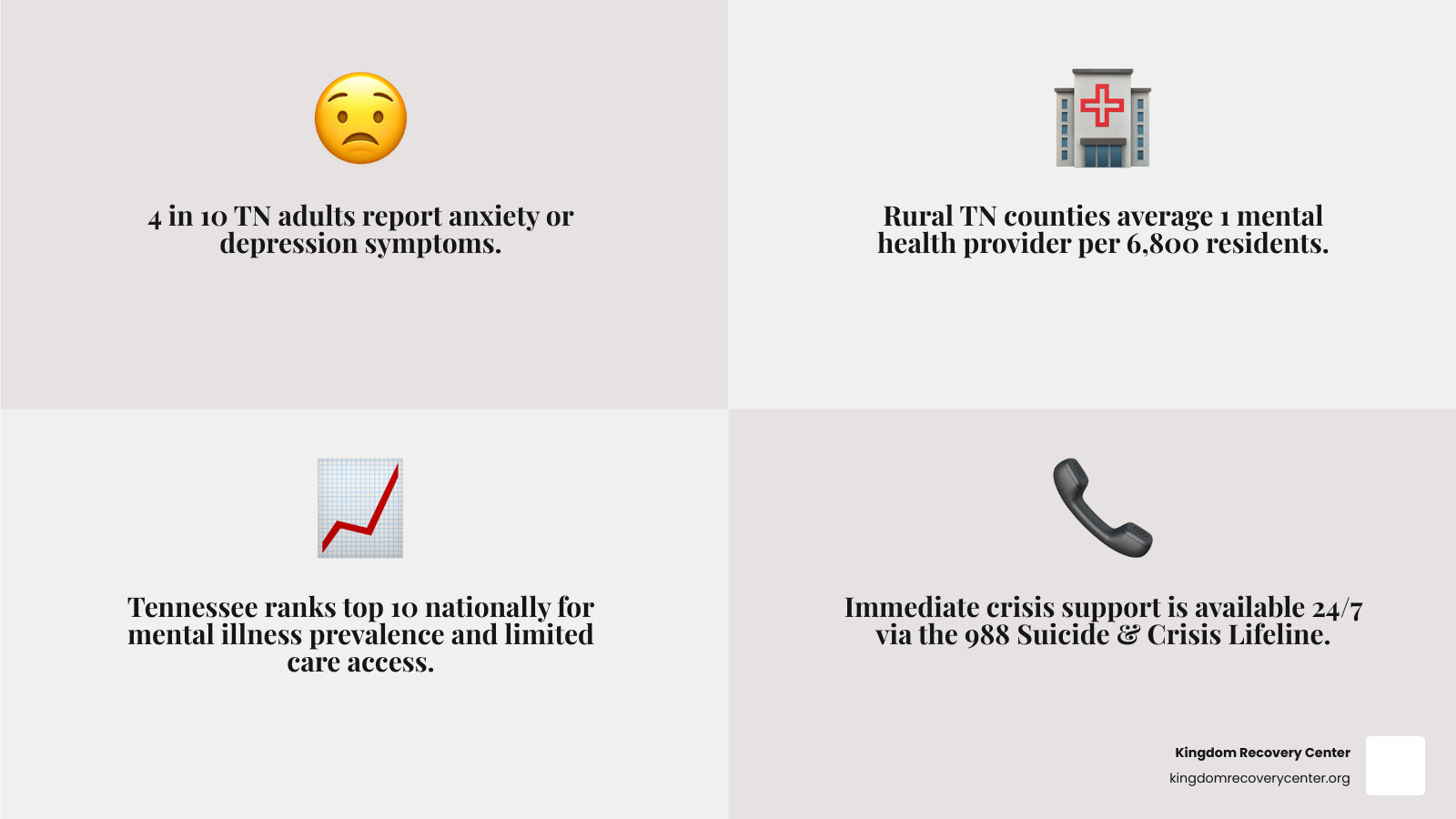
Mental health Grainger TN residents face significant challenges in accessing care, but multiple resources exist to support individuals struggling with anxiety, depression, substance use, and other mental health conditions. Nearly 4 in 10 Tennessee adults report symptoms of anxiety or depression-a rate higher than the national average-and rural counties like Grainger often face extreme provider shortages.
Quick Access to Mental Health Services in Grainger County:
- Emergency Crisis Support: Call 988 (Suicide & Crisis Lifeline) or text “TN” to 741-741 for immediate help 24/7
- Local Health Services: Grainger County Health Department offers confidential clinical services with income-based fees
- Mobile Outreach: Regional providers operate mobile mental health outreach services that can help serve rural communities like Grainger County
- Nearby Providers: Integrated behavioral health and primary care options are available in surrounding East Tennessee communities
- Specialized Treatment: Kingdom Recovery Center in nearby Morristown provides comprehensive addiction and mental health services
- Uninsured Support: Tennessee Behavioral Health Safety Net provides essential services regardless of ability to pay (800-560-5767)
The reality is stark: some Tennessee counties have only one mental health provider for every 6,800 residents. This shortage creates barriers for individuals seeking treatment for depression, anxiety, trauma, or co-occurring substance use disorders. However, Grainger County residents aren’t alone in this struggle.
Tennessee ranks among the top 10 states for both mental illness prevalence and limited access to care. Rural areas face particularly severe challenges, with many families traveling significant distances for basic mental health services. The impact extends beyond individual suffering-untreated mental health conditions strain emergency rooms, disrupt workplaces and schools, and perpetuate cycles of generational trauma and poverty.
If you want a national overview of how mental health care access is tracked and compared, the Mental Health America overview provides helpful context on access and prevalence measures.
At Kingdom Recovery Center in nearby Morristown, we specialize in providing compassionate, evidence-based treatment for individuals facing mental health challenges and addiction throughout the Grainger County area. Our holistic approach addresses both mental health Grainger TN residents struggle with and co-occurring substance use disorders through personalized treatment plans.
Navigating Mental Health Grainger TN: Available Services and Support
Finding the right mental health services can feel overwhelming, especially in a rural area. However, residents of Grainger County have several avenues for support, ranging from local health departments to specialized regional centers and even mobile outreach programs. Our goal at Kingdom Recovery Center is to help you understand these options so you can make informed decisions about your well-being.
The Grainger County Health Department plays a crucial role in the local community. Its mission is clear: “To protect, promote and improve the health and prosperity of people in Tennessee.” This commitment extends to mental health by ensuring access to confidential clinical services for all residents, regardless of age, sex, income, race, disability, or marital status. While the health department may not offer extensive specialized mental health programs, it serves as a vital entry point for care, providing clinical services and referrals.
For more comprehensive mental health and substance use services, Grainger County residents can turn to regional providers. In East Tennessee, community mental health organizations provide a continuum of care from childhood through adulthood. Crucially for rural areas, some organizations operate mobile mental health clinics and outreach services that can serve communities like Grainger County, helping to bridge the gap in access. This type of mobile support brings essential services closer to residents who might otherwise struggle with transportation to traditional clinics.
At Kingdom Recovery Center, located in nearby Morristown, we pride ourselves on offering client-centered, evidence-based addiction and mental health treatment. Our specialized programs address the unique needs of individuals, including those with co-occurring disorders, empowering lasting change. We understand the challenges faced by those in rural communities and strive to provide accessible, high-quality care.
An integrated care approach-which is foundational to our dual diagnosis programs at Kingdom Recovery Center-means that your mental health is not treated in isolation. Instead, a team of professionals works together to address all aspects of your well-being. This can involve behavioral health clinicians collaborating with medical providers, ensuring a holistic understanding and treatment plan for each individual.
The availability of mobile outreach and the increasing accept of telehealth options are changing how mental health Grainger TN residents can access support. These innovations help overcome geographical barriers and transportation challenges common in rural settings.
| Feature | In-Person Support | Telehealth Support |
|---|---|---|
| Accessibility | Requires travel, limited by location | Accessible from home, wider reach |
| Engagement | Direct human connection, non-verbal cues | Convenient, flexible scheduling |
| Privacy | Can feel more secure in a professional setting | Requires private space at home |
| Services Offered | Full range, including crisis stabilization, group therapy | Counseling, medication management, individual therapy |
| Cost | May include travel expenses, potentially higher fees | Often more affordable, reduces indirect costs |
| Crisis Care | Preferred for immediate, severe crisis situations | Best for follow-up or less acute support, initial screening |

Affordable Mental Health Grainger TN Options for the Uninsured
One of the most significant barriers to mental health care is cost, particularly for individuals who are uninsured or underinsured. However, several resources are dedicated to ensuring that financial limitations do not prevent Grainger County residents from receiving the care they need.
The Grainger County Health Department is committed to accessibility. Most service fees are based on income and family size, ensuring affordability. Crucially, their policy states that no one will be denied services because of an inability to pay. This commitment makes the health department a vital first stop for many seeking confidential clinical services without financial stress.
Beyond local initiatives, the Tennessee Behavioral Health Safety Net provides essential mental health services across the state. This program is designed for adults aged 18 and older who have no other means to pay for care and meet specific eligibility criteria. For children aged 3 to 17, the Safety Net offers services regardless of family income if they are uninsured or underinsured, making it a critical lifeline for families.
At Kingdom Recovery Center, we believe that quality mental health and addiction treatment should be accessible to everyone. We work with individuals and families to explore payment options and ensure that financial concerns do not stand in the way of recovery. Understanding your options is the first step toward getting help, and we encourage you to explore resources like our guide to finding appropriate treatment. For a comprehensive overview of how to steer these options, we have compiled detailed information in our resource: Your Guide to Finding the Right Mental Health Treatment in Tennessee.
Finding Long-Term Mental Health Grainger TN Support
Long-term mental health support is crucial for managing chronic conditions, fostering resilience, and achieving lasting well-being. For mental health Grainger TN residents, a range of treatment options is available, focusing on therapy, medication management, and comprehensive outpatient care.
Therapy is a cornerstone of mental health treatment. Options include individual therapy, where you work one-on-one with a counselor; group therapy, which provides peer support and shared experiences; and family therapy, which addresses relational dynamics. Providers in the region offer various therapeutic modalities. At Kingdom Recovery Center in Morristown, our evidence-based therapeutic approaches are custom to each individual, incorporating techniques such as Cognitive Behavioral Therapy (CBT), Motivational Improvement Therapy (MET), and Dialectical Behavior Therapy (DBT) to address underlying issues and develop coping skills.
Medication management, when appropriate, is often an integral part of a comprehensive treatment plan. This involves working with a psychiatrist or other prescribing provider to find the right medications to alleviate symptoms of conditions like depression, anxiety, or bipolar disorder. At Kingdom Recovery Center, our team coordinates care to ensure effective medication management alongside therapy.
Outpatient counseling allows individuals to receive treatment while continuing with their daily lives. This can include regular appointments for therapy sessions, medication reviews, and participation in support groups. Regional providers and outpatient clinics in surrounding communities may also offer individual and family counseling and medication management.
For those managing chronic mental health conditions, an integrated care model can be particularly beneficial. This model ensures that both physical and mental health needs are addressed holistically, preventing conditions from being treated in isolation. Our approach at Kingdom Recovery Center also emphasizes integrated care, especially for individuals with co-occurring mental health and substance use disorders, ensuring that all aspects of their health are supported.
Finding the right long-term support means exploring the options that best fit your needs and circumstances. We believe in empowering you with the knowledge to seek effective treatment. To learn more about various therapeutic approaches and how they can support your journey to recovery, we encourage you to read our guide: Effective Ways to Seek Mental Health Treatment in Tennessee.
Accessing Crisis Support and Emergency Care
When a mental health crisis strikes, immediate access to support is paramount. Fortunately, a robust crisis services continuum is growing across Tennessee, including vital resources for mental health Grainger TN residents. Knowing how to access these services can make a life-saving difference.
The primary lifeline for anyone experiencing a mental health crisis in Tennessee is the 988 Suicide & Crisis Lifeline. By simply calling or texting 988 and pressing 0, you can connect with a crisis counselor 24/7. This number directly links you to the crisis services provider covering your local area, ensuring a localized and immediate response.
Tennessee’s Mobile Crisis Services are another critical component of emergency care. These teams operate 24/7/365, responding to people experiencing a mental health emergency statewide for both adults and children/youth. Services include telephone assessment, face-to-face or telehealth assessment, referral, stabilization, and follow-up. Regional Mobile Crisis teams serve East Tennessee, including Grainger County, making it possible for help to come directly to you.
For those who can travel, Crisis Walk-In Centers offer 24/7/365 face-to-face evaluation for mental health emergencies. These centers provide immediate mental health assessment and up to 23 hours of observation, along with referrals and follow-up services. While there may not be a dedicated walk-in center in Grainger County itself, these facilities are part of the broader Tennessee crisis network.
More intensive, short-term stabilization can be found at Crisis Stabilization Units (CSUs). These units offer 24/7/365 care for individuals experiencing a mental health emergency who are willing to receive services. With an average stay of about three days, CSUs provide counseling, medication management, stress management, and treatment plan development, all free of charge. Similarly, Crisis Respite Services offer short-term relief, typically 48 hours or less, including medication management, illness management, and peer support. Both CSUs and Crisis Respite Services require a referral from Mobile Crisis Services or Crisis Walk-In Services.
For children and youth experiencing a psychiatric emergency, the Tennessee Youth Crisis Hotline provides 24/7 crisis support. You can reach them at (866) 791-9224. This specialized hotline ensures that younger individuals receive the appropriate and timely intervention they need.
At Kingdom Recovery Center, we understand the urgency of mental health crises. While we are not an emergency crisis center, we are here to provide immediate consultation and can guide individuals and families toward the most appropriate crisis resources in the Grainger County area and East Tennessee. For a comprehensive guide on navigating mental health treatment options, including crisis services, refer to our Mental Health Treatment Tennessee Guide.
The Connection Between Mental Health and Substance Use
The relationship between mental health conditions and substance use disorders is incredibly complex and often intertwined. It’s a common misconception that these are entirely separate issues; in reality, they frequently trigger and exacerbate one another. Understanding this connection is vital for effective treatment and lasting recovery, particularly for mental health Grainger TN residents struggling with both.
Research indicates a strong link: individuals with anxiety or mood disorders are two to three times more likely to abuse drugs than those without these conditions. This is often due to self-medication, where individuals turn to substances like alcohol or opioids to cope with undiagnosed or untreated symptoms of depression, anxiety, or trauma. While providing temporary relief, this practice inevitably worsens the underlying mental health condition and can lead to addiction.
Furthermore, substance abuse itself can cause chemical imbalances in the brain, which can trigger or exacerbate mood disorders. For example, prolonged alcohol abuse can lead to depression, and stimulant use can induce anxiety or even psychotic episodes. This creates a vicious cycle where substance use worsens mental health, which in turn drives further substance use.
At Kingdom Recovery Center in Morristown, we specialize in dual diagnosis treatment, which means we address both mental health and substance use disorders concurrently. This integrated approach is crucial because treating one condition without addressing the other often leads to relapse. Our programs are designed to provide comprehensive care that tackles the root causes of both issues, offering a path to integrated recovery. You can learn more about how we approach this in our Co-Occurring Treatment Programs Tennessee.
Our treatment modalities for co-occurring conditions include a range of therapies, medication management, and holistic practices. We use evidence-based therapies such as Cognitive Behavioral Therapy (CBT) and Dialectical Behavior Therapy (DBT), alongside group therapy to foster peer support and individual therapy to dig into personal challenges. For those requiring medical intervention, Medication-Assisted Treatment (MAT) is often employed, particularly for opioid and alcohol addiction, in conjunction with behavioral therapy to support sustained recovery.
Aftercare planning is also a vital component of our approach. We understand that recovery is a long-term journey, and continued support through ongoing therapy, support groups, and relapse prevention strategies is essential for maintaining sobriety and managing mental health conditions effectively. For a deeper dive into this complex relationship and how integrated treatment can help, we invite you to explore Dual Diagnosis Demystified: Finding Your Path to Integrated Recovery.
Addressing addiction effectively requires a nuanced understanding of its causes and manifestations. To explore our comprehensive approach to substance use disorders, please Learn more about addiction treatment.
Mental Health Initiatives in Grainger County Schools
Schools play an increasingly vital role in supporting the mental well-being of students, recognizing that academic success is intrinsically linked to mental health. In Grainger County, the Coordinated School Health (CSH) program is a key initiative addressing the holistic health of students, which inherently includes mental health.
The vision of Grainger County Coordinated School Health is to be a catalyst for healthy lifestyle choices in schools and the wider community. This program, supported and funded by the Tennessee Department of Education Coordinated School Health Act, aims to improve student health and their capacity to learn. A significant aspect of this effort is the staffing of a full-time registered nurse at each of Grainger County’s seven schools. These school nurses are often the first point of contact for students experiencing health issues, including those that may have mental health components.
A critical area of focus for mental well-being in schools is addressing Adverse Childhood Experiences (ACEs). Statistics show that half of U.S. children experience at least one ACE, such as abuse, neglect, parental incarceration, or household addiction. These experiences can have profound, long-lasting impacts on mental health, increasing the risk of depression, chronic illness, and academic failure. Grainger County schools, through their CSH initiatives, aim to create supportive environments that can mitigate the effects of ACEs and promote Positive Childhood Experiences (PCEs), which are known to significantly lower these risks.
The CSH program also engages in various activities that indirectly support mental health, such as student health screenings, safety education, and youth risk behavior surveys. These surveys provide valuable data that can inform school-based interventions and identify prevalent issues affecting student well-being. By fostering a healthy and supportive school environment, Grainger County schools contribute to the emotional and psychological development of their students.
While specific mental health counseling services directly within every school might be limited, the presence of school nurses, the focus on a coordinated health approach, and the awareness of issues like ACEs create a foundational support system. Schools can also serve as crucial referral points to external mental health services in the community, connecting students and families with the resources they need.
At Kingdom Recovery Center, we recognize the immense impact early interventions and a supportive school environment can have on a child’s mental health trajectory. We believe that understanding the therapeutic process is essential for students, parents, and educators alike. For more insights into how therapy can make a difference in mental health recovery, we recommend reading Understanding Therapy’s Impact on Mental Health Recovery.
Frequently Asked Questions about Mental Health in Grainger County
Navigating mental health care can bring up many questions. Here, we address some common inquiries specific to mental health Grainger TN residents.
What mental health services are available for those without insurance in Grainger County?
Residents of Grainger County who are uninsured or underinsured have several options for accessing mental health services:
- Grainger County Health Department: Offers confidential clinical services with fees based on income and family size. Importantly, no one will be denied services due to an inability to pay.
- Tennessee Behavioral Health Safety Net: This statewide program provides essential mental health services. For adults (18+), it serves those who have no other means to pay and meet eligibility criteria. For children (3-17), services are available regardless of family income if they are uninsured or underinsured. You can call (800) 560-5767 for more information.
- Community Health Centers: Several federally qualified health centers and community providers in the East Tennessee region offer integrated primary care and behavioral health services on a sliding fee scale, making care more affordable for those without insurance.
- Mobile Mental Health Clinics: Regional mobile outreach services that serve Grainger County may offer services or referrals regardless of insurance status, helping to remove barriers to care.
We at Kingdom Recovery Center are committed to helping you find the right resources, regardless of your financial situation.
How can I access immediate crisis mental health support in Tennessee?
If you or someone you know is experiencing a mental health crisis in Grainger County or anywhere in Tennessee, immediate help is available:
- 988 Suicide & Crisis Lifeline: Call or text 988, and press 0 to connect directly with a trained crisis counselor 24/7. This service will connect you to local resources.
- Mobile Crisis Services: Available 24/7/365 statewide for adults and children/youth. These teams can provide telephone assessment, face-to-face or telehealth assessment, stabilization, and referral. Regional providers offer these services throughout East Tennessee.
- Tennessee Youth Crisis Hotline: For youth experiencing a psychiatric emergency, call (866) 791-9224 for 24/7 support.
- Emergency Services: In life-threatening situations, always call 911 or go to the nearest emergency department.
You don’t have to face a crisis alone. These services are designed to provide immediate support and connection to further care.
What is the relationship between depression and substance use?
The relationship between depression and substance use is a strong and often dangerous cycle. It’s not uncommon for individuals with depression to turn to substances as a way to self-medicate their painful symptoms, such as sadness, hopelessness, or anxiety. While substances might offer temporary relief, they ultimately worsen depressive symptoms, create chemical imbalances in the brain, and can lead to addiction.
Conversely, substance abuse can also cause or trigger depressive episodes. The physiological effects of drugs and alcohol, combined with the lifestyle changes and consequences often associated with addiction, can deepen feelings of despair and hopelessness. This interconnectedness is why treating both conditions simultaneously, known as dual diagnosis or co-occurring disorder treatment, is crucial for effective and lasting recovery. At Kingdom Recovery Center, we specialize in these integrated treatment approaches, recognizing that true healing addresses both the mental health and substance use challenges together.
Conclusion
The journey from stress to serenity is a deeply personal one, yet no one should have to walk it alone. For mental health Grainger TN residents, while challenges exist, a growing network of compassionate and effective resources is available. From the foundational support of the Grainger County Health Department to innovative mobile clinics and integrated care models throughout East Tennessee, help is within reach.
We believe in the power of community resilience and the importance of breaking down the stigma surrounding mental health and addiction. Every step we take to acknowledge these struggles and seek support strengthens not only individuals but also families and the entire community.
At Kingdom Recovery Center in Morristown, we are dedicated to providing client-centered, evidence-based care for addiction, mental health, and behavioral health. Our individualized treatment paths are designed to empower lasting change, helping you find the serenity and stability you deserve. We understand that mental health is integral to holistic well-being, and our integrated approach ensures that all aspects of your health are considered.
If you or a loved one in Grainger County is struggling, reaching out is a sign of strength. Explore the resources available, knowing that a path to healing and recovery is possible. For more information on how holistic approaches can support your well-being, visit our page on Mental Health and Holistic Healing.
Your journey toward a healthier, happier life begins with a single step. We are here to support you every step of the way. Start your recovery journey today.