
When Alcohol Treatment Knoxville TN Could Be the Right Next Step
Alcohol treatment Knoxville TN is available through multiple local rehab centers offering a full range of care — from medical detox and residential programs to flexible outpatient options like PHP and IOP.
Here’s a quick overview of what alcohol treatment in Knoxville typically includes:
| Type of Care | What It Involves |
|---|---|
| Medical Detox | 24/7 supervised withdrawal management |
| Residential/Inpatient | Structured live-in treatment, usually 25–35 days |
| PHP (Partial Hospitalization) | Intensive daily care, return home in evenings |
| IOP (Intensive Outpatient) | 9–12 hours per week of therapy and education |
| MAT (Medication-Assisted Treatment) | Medications like buprenorphine combined with counseling |
| Dual Diagnosis | Treats addiction alongside mental health conditions |
| Aftercare/Peer Support | Relapse prevention and ongoing recovery coaching |
But knowing which type of care fits your situation — that’s where most people get stuck.
Right now, more than 28.3 million people age 12 and older in the United States are struggling with alcohol addiction. Yet many still wonder whether their situation is “serious enough” to seek professional help. The truth is, alcohol use disorder is a chronic condition that changes brain chemistry. Willpower alone rarely works.
That’s why this guide exists — to help you recognize the clear signs that professional alcohol treatment is the right move for you.
At Kingdom Recovery Center, based in Morristown, TN, we specialize in compassionate, evidence-based addiction recovery and mental health services — and we understand what it takes to support individuals seeking alcohol treatment Knoxville TN and across East Tennessee. Whether you’re just starting to ask questions or ready to take action, we’re here to walk you through every step.
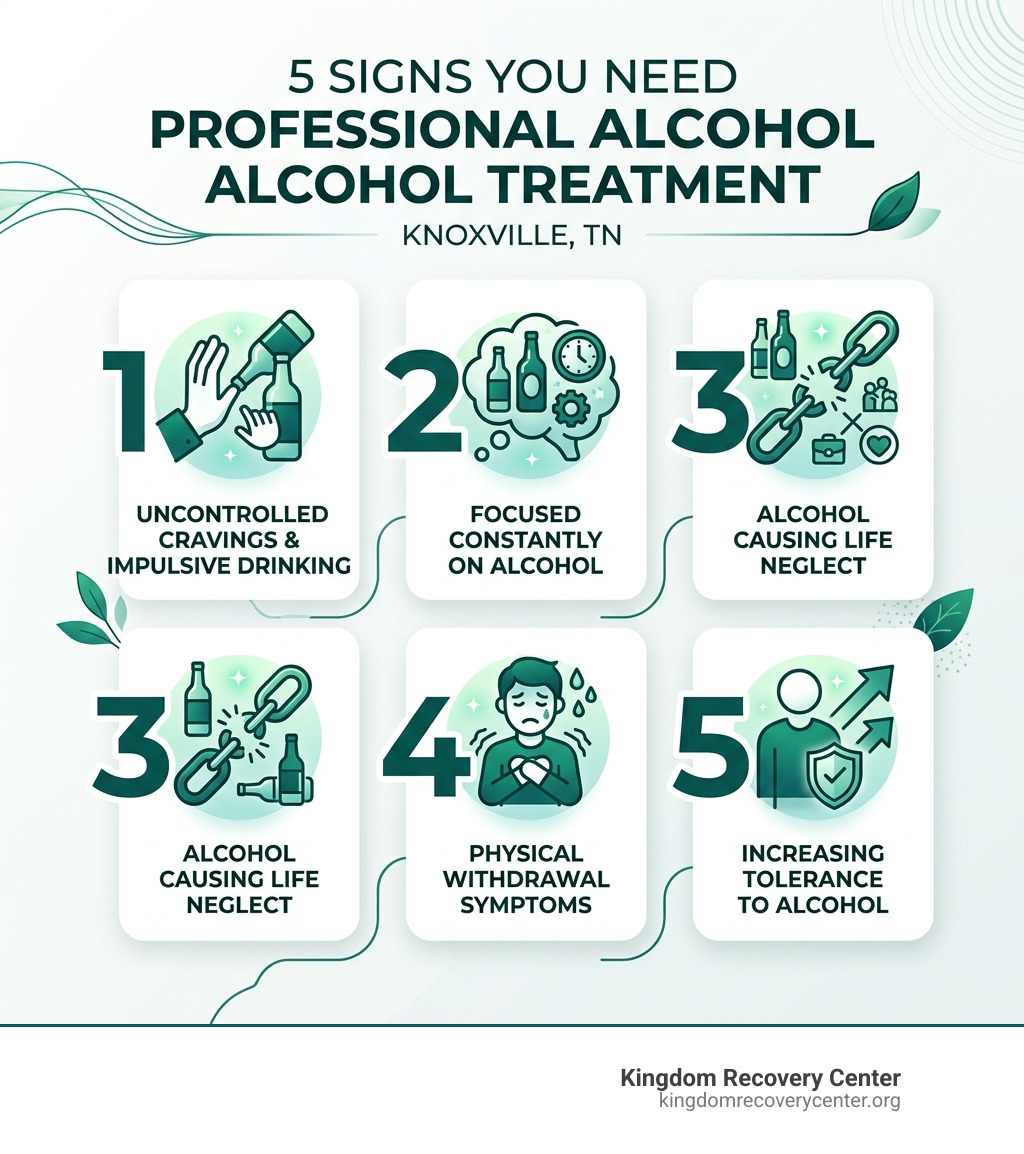
Alcohol treatment Knoxville TN vocab explained:
- Knoxville alcohol addiction treatment alternatives
- inpatient alcohol rehab Tennessee
- residential dual diagnosis treatment centers near knoxville tn
Way 1: You Experience Physical Withdrawal or Intense Cravings
One of the most undeniable signs that you need professional alcohol treatment Knoxville TN is the presence of physical withdrawal symptoms. When the body becomes dependent on alcohol, the central nervous system adjusts to its constant presence. If you stop drinking abruptly, your system goes into a state of shock.
The timeline for alcohol withdrawal is predictable but can be dangerous if not managed by experts. Generally, symptoms begin within 6 to 12 hours after the last drink. These early signs often include anxiety, shaky hands (the “tremors”), and nausea. By the 12 to 48-hour mark, symptoms can intensify into hallucinations or even seizures. The most critical window is the 48 to 72-hour peak, where the risk for Delirium Tremens (DTs)—a life-threatening condition involving confusion and rapid heartbeat—is at its highest.
Trying to “white knuckle” this process at home isn’t just difficult; it’s risky. Professional alcohol detox Knoxville programs provide 24/7 medical supervision to ensure your safety. Using physician-approved protocols, medical teams can manage these symptoms, making the transition to sobriety much more comfortable. According to scientific research on Tennessee detox protocols, medically managed withdrawal is the safest first step toward long-term recovery.
If you find that your day revolves around when you can have your next drink, or if you feel physically ill when you try to cut back, your body is telling you it needs help. Physical dependence isn’t a failure of character; it’s a medical condition that requires a medical solution.
Way 2: Your Mental Health and Drinking Habits are Intertwined
There is a profound connection between how we feel and how we use substances. In the addiction treatment world, we call this “Dual Diagnosis.” This means a person struggles with both a substance use disorder and a mental health condition, such as depression, anxiety, PTSD, or bipolar disorder.
Statistics from 2026 show that adults who suffered from a mental illness in the past year (28.5%) were significantly more likely to binge-drink alcohol than those who didn’t (22.8%). The numbers are even more stark for young people; adolescents with mental health concerns (6.2%) were nearly twice as likely to binge-drink as their peers without such concerns (3.8%).
If you find yourself drinking to “numb” the pain of trauma or to quiet an anxious mind, you are likely dealing with co-occurring disorders. Treating just the drinking without addressing the underlying mental health issue is like trying to fix a leaky pipe by just mopping the floor—the water will keep coming back.
At Kingdom Recovery Center, we believe in treating the whole person. Our behavioral health services are designed to uncover the “why” behind the addiction. By integrating scientific research on alcohol rehab in Tennessee, we provide care that addresses the psychological roots of substance use. When mental health and drinking habits are intertwined, specialized alcohol treatment Knoxville TN is the most effective way to achieve lasting peace.
Way 3: You Need Structured Levels of Care for Alcohol Treatment Knoxville TN
Recovery isn’t a one-size-fits-all journey. Some people need the intense structure of a live-in facility, while others need a program that allows them to maintain their job or family life. If your attempts to quit have been unsuccessful because life “gets in the way,” a structured level of care might be exactly what you need.
Knoxville-area facilities offer various levels of support to meet you where you are. For those who need maximum stability, Knoxville inpatient drug rehab provides a safe, substance-free environment where you can focus entirely on healing. For others, outpatient models offer a middle ground.
| Program Type | Weekly Commitment | Best For |
|---|---|---|
| PHP (Partial Hospitalization) | 20+ hours (usually 5 days/week) | Those transitioning from detox who need high structure but want to sleep at home. |
| IOP (Intensive Outpatient) | 9-12 hours (usually 3 sessions/week) | Those with a stable home environment who are working or attending school. |
| MAT (Medication-Assisted Treatment) | Varies by clinical need | Managing cravings and preventing relapse using FDA-approved medications. |
These programs aren’t just about “not drinking.” They involve evidence-based therapies like Cognitive Behavioral Therapy (CBT), Dialectical Behavior Therapy (DBT), and trauma-informed care. These tools help you rebuild your life while you are still living it.
Specialized Alcohol Treatment Knoxville TN for High-Risk Groups
We also recognize that certain populations face unique challenges. Veterans, for instance, often deal with service-related trauma that requires specialized care. Similarly, women’s programs might focus on specific issues like childcare, domestic safety, or hormonal health. Adolescents require a different approach entirely, focusing on brain development and family dynamics. If you belong to one of these groups, looking for a drug rehab in Knox County that offers specialized tracks can significantly improve your outcomes.
Way 4: Previous Attempts to Quit Independently Have Failed
If you’ve ever said, “This is the last time,” only to find yourself with a drink in your hand a few days later, you aren’t alone. Alcoholism is a chronic, relapsing brain disease. It isn’t a matter of not having enough willpower; it’s a matter of brain chemistry.
Prolonged alcohol use alters the brain’s reward system. Over time, the brain forgets how to produce “feel-good” chemicals like dopamine on its own. It begins to rely on alcohol just to feel “normal.” When you try to quit independently, you are fighting against your own biology. This is why alcohol abuse treatment is so vital. It provides the time and tools necessary for the brain to begin healing.
Research suggests that longer treatment stays—often 90 days or more—drastically improve the chances of lifetime sobriety. During this time, you learn relapse prevention skills and often participate in 12-step integration or SMART Recovery groups. These communities provide the peer support that is often missing when someone tries to quit alone. Scientific research on addiction treatment in Morristown emphasizes that a combination of medical intervention and community support is the “gold standard” for overcoming chronic relapse.
Way 5: You Require Professional Help to Navigate Insurance and Admissions
Sometimes the biggest barrier to getting help isn’t the desire to get sober—it’s the paperwork. Navigating insurance, deductibles, and “in-network” vs. “out-of-network” providers can be overwhelming, especially when you’re already struggling with the weight of addiction.
If you are putting off treatment because you don’t think you can afford it, or because you don’t know where to start, professional rehab centers in Knoxville Tennessee can help. Most reputable centers have dedicated admissions teams whose entire job is to handle the logistics for you.
Local centers frequently work with a wide variety of plans. Whether you have private insurance through an employer or state-funded coverage, there are options available. For example, scientific research on finding rehab in Johnson City shows that many Tennessee facilities are specifically set up to handle the nuances of local coverage.
Verifying Insurance for Alcohol Treatment Knoxville TN
The good news is that verifying your insurance is usually free and incredibly fast. Many facilities can give you a clear picture of your coverage in as little as five minutes.
- TennCare/BlueCare: Many Knoxville facilities accept state-funded plans, ensuring that high-quality care is accessible to everyone.
- Commercial Plans: Providers like UnitedHealthcare, Amerigroup, Ambetter, and Cigna are commonly accepted.
- Medicaid/Medicare: Some centers offer specific programs for those utilizing these benefits.
Don’t let the fear of the “bill” stop you from saving your life. Use a guide to alcohol and drug rehab in Knoxville to find a center that prioritizes your health over your wallet.
Frequently Asked Questions about Alcohol Recovery
How long does alcohol withdrawal last?
The physical “detox” phase typically lasts between 5 and 7 days. Symptoms usually start within 6-12 hours, peak around the 48-72 hour mark, and begin to fade after the 5th day. However, psychological cravings can last much longer, which is why transitioning into a residential or outpatient program following detox is highly recommended.
Does TennCare cover alcohol rehab in Knoxville?
Yes, many facilities in the Knoxville and Morristown areas accept TennCare and its associated plans like BlueCare and UnitedHealthcare Community Plan. Coverage typically includes medical detox and can often extend to residential or intensive outpatient care, depending on the specific plan and medical necessity.
What is the difference between PHP and IOP?
The main difference is the intensity and time commitment. PHP (Partial Hospitalization) is essentially a “full-time job” for recovery, involving 20+ hours of therapy per week. IOP (Intensive Outpatient) is more flexible, typically requiring 9-12 hours per week. Both allow you to return home at night, but PHP offers a higher level of clinical support.
Conclusion
As of April 2026, the landscape of alcohol treatment Knoxville TN is more supportive and accessible than ever before. Whether you are dealing with physical withdrawal, struggling with a dual diagnosis, or simply tired of the cycle of chronic relapse, there is a path forward.
At Kingdom Recovery Center, we are dedicated to helping our neighbors in Knoxville, Morristown, and throughout East Tennessee find their way back to a fulfilling, substance-free life. We offer client-centered, evidence-based care that focuses on lasting change. You don’t have to do this alone.
If you’re ready to take the first step, we invite you to explore Knoxville’s road to recovery and discover the treatment options that can help you reclaim your future. Your recovery is possible, and it can start today.