
Beyond Sobriety to Whole-Person Healing
Comprehensive addiction treatment is an approach that addresses not just substance use, but the physical, mental, emotional, social, and spiritual factors that contribute to addiction. Rather than focusing solely on stopping drug or alcohol use, this model treats the whole person through a combination of medical care, therapy, medication management, family support, and aftercare planning custom to individual needs.
Key Elements of Comprehensive Addiction Treatment:
- Medical detoxification – Safe withdrawal management with 24/7 supervision
- Behavioral therapies – CBT, DBT, trauma-informed care, and motivational techniques
- Medication-assisted treatment (MAT) – FDA-approved medications to reduce cravings and prevent relapse
- Dual diagnosis care – Integrated treatment for co-occurring mental health disorders
- Family involvement – Education, therapy, and support for loved ones
- Aftercare planning – Relapse prevention strategies and long-term support systems
- Multiple levels of care – Inpatient, residential, PHP, IOP, and outpatient options
Addiction is a chronic brain disease, not a moral failing. Research shows that long-term drug abuse changes brain circuits involved in reward, motivation, and self-control. These changes persist long after someone stops using substances, which is why comprehensive treatment must address the root causes of addiction rather than just the symptoms.
The good news? Recovery is possible. Studies demonstrate that people who enter treatment and stay engaged stop using drugs, reduce criminal activity, and improve their work and social functioning. Every dollar invested in addiction treatment returns between $4 and $7 in reduced drug-related crime and justice costs—and up to $12 when healthcare savings are included.
Treatment works best when it’s individualized. What helps one person may not work for another. That’s why comprehensive programs assess your unique situation—your substance use history, mental health, physical health, family dynamics, legal issues, and personal goals—to create a custom plan just for you.
At Kingdom Recovery Center, we provide compassionate, evidence-based comprehensive addiction treatment to individuals throughout Tennessee who are ready to reclaim their lives from substance use and co-occurring mental health challenges. Our team has helped countless people build lasting recovery through personalized care that addresses every aspect of healing.
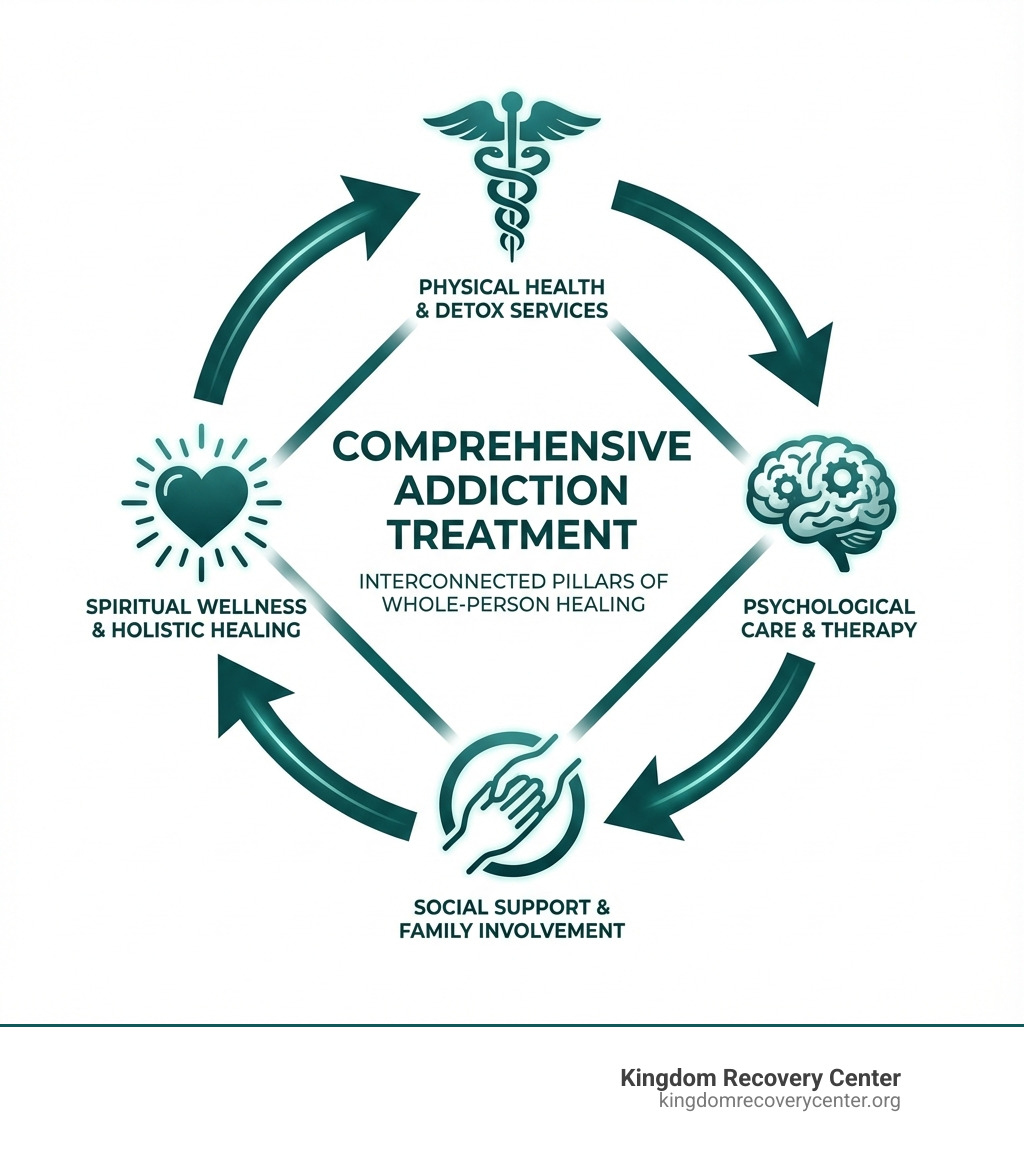
The Core Components of Comprehensive Addiction Treatment
Comprehensive addiction treatment isn’t a quick fix; it’s a roadmap to a healthier life. Because addiction is a complex issue affecting every facet of a person’s well-being, our approach integrates various strategies to meet all needs. According to the National Institute on Drug Abuse (NIDA), effective treatment addresses not only drug use but also helps restore a person’s productive role in society.
At the heart of our programs are highly individualized treatment plans. Since no two individuals are alike, we assess each person’s unique situation—substance use history, co-occurring conditions, medical needs, and personal goals—to tailor an effective plan, recognizing that “no single treatment is appropriate for everyone.”
Medical detoxification is often a crucial first step, safely managing the acute physical symptoms of withdrawal. However, detox is just the beginning. As NIDA emphasizes, it manages physiological effects but doesn’t produce lasting behavioral changes. It’s a necessary preparation for the deeper therapeutic work ahead, which we ensure is medically supervised for comfort and safety. You can learn more about this initial phase by visiting our guide on What to Expect After Detox: Preparing for Your Recovery Path.
Following detox, behavioral therapies, sometimes combined with medication management, become the cornerstone of treatment. A robust aftercare plan is also essential for long-term success. These principles align with leading research on effective addiction care, as detailed in the Principles of Drug Addiction Treatment: A Research-Based Guide (Third Edition) .

The Multidisciplinary Team: Your Circle of Support
Effective comprehensive addiction treatment is a team effort. A multidisciplinary team is crucial for addressing the many issues addiction presents. At Kingdom Recovery Center, our team includes addiction specialists, psychiatrists, medical doctors, licensed therapists, and case managers, all collaborating to provide seamless care.
Each member brings unique expertise:
- Addiction Specialists and Therapists guide you through behavioral therapies and counseling.
- Psychiatrists manage mental health conditions and medication needs.
- Medical Doctors oversee your physical health.
- Case Managers coordinate care, connect you with resources, and help with practical challenges.
- Peer Support Specialists offer insight from their lived experience, providing mentorship and hope.
This collaborative approach ensures every aspect of your health—physical, mental, and emotional—is addressed. This integrated model creates a client-centered experience, making your recovery journey stronger. To understand more about the benefits of professional help, see our page on Who Benefits from Professional Treatment During Rehab?.
The Role of Family in Comprehensive Addiction Treatment
Addiction impacts the entire family, making family involvement a cornerstone of comprehensive addiction treatment. Healing relationships and building a strong home support system are vital for lasting recovery. Our programs include family therapy, education, and communication improvement.
Research shows family involvement increases the likelihood that individuals enter and remain in treatment. Our family programs aim to:
- Educate loved ones about addiction, dispelling myths and reducing stigma.
- Improve communication patterns within the family.
- Build a strong support system at home.
- Heal relationships strained by addiction.
Engaging the family helps create a unified front against addiction, empowering everyone to contribute positively to the recovery process. For more insights on the power of community, explore Embracing Community in the Journey of Addiction Recovery.
Evidence-Based Therapeutic Modalities
Our comprehensive addiction treatment relies on evidence-based therapeutic modalities—approaches proven effective by research. These therapies provide the tools and strategies needed to achieve and maintain sobriety.
Here are some of the common therapies we offer:
- Cognitive Behavioral Therapy (CBT): Helps individuals identify and change unhelpful thought patterns and behaviors related to substance use, equipping them with coping skills for triggers and cravings.
- Dialectical Behavior Therapy (DBT): An extension of CBT, DBT teaches skills in mindfulness, distress tolerance, emotion regulation, and interpersonal effectiveness. It’s effective for those with intense emotions and relationship difficulties. Learn more in Understanding the Synergy of CBT and DBT in Recovery.
- Motivational Improvement Therapy (MET): This non-confrontational approach helps resolve ambivalence about treatment, strengthening intrinsic motivation to commit to recovery.
- Trauma-Informed Care: Since many with addiction have experienced trauma, this approach integrates an understanding of trauma into all aspects of treatment, creating a safe environment to process past experiences.
- Holistic Therapies: We also incorporate holistic approaches like mindfulness, yoga, and art therapy to nurture the mind, body, and spirit. Find more about these practices in Holistic Therapies for Addiction Treatment.
These are scientifically validated methods that provide practical skills for navigating recovery.
A Spectrum of Care: Finding the Right Level for Your Needs
Comprehensive addiction treatment recognizes that recovery isn’t a one-size-fits-all journey. We offer a full spectrum of care to match each person’s unique needs at different stages. This continuum allows individuals to step up or down in intensity as their recovery progresses.
Choosing the right level of care is critical and begins with a professional assessment. Factors like addiction severity, co-occurring disorders, medical stability, and social support all play a role. Our goal is to find the optimal balance of structure, support, and independence for you. To help you steer these choices, explore our guides on Outpatient vs. Inpatient Rehab: Which is Best for You? and What to Assess When Choosing the Right Recovery Center.
Inpatient and Residential Treatment
For those needing intensive support, inpatient and residential programs offer a structured, immersive environment with 24/7 medical supervision. They are ideal for severe addiction, complex medical needs, or unstable home environments. In a residential setting, you live on-site, removed from daily triggers, allowing total focus on recovery. This is often where medically assisted detox takes place. Our Knoxville Inpatient Drug Rehab provides a safe haven for this level of care.
Partial Hospitalization Programs (PHP)
Partial Hospitalization Programs (PHPs), or “day treatment,” bridge inpatient and outpatient care. PHPs provide intensive, structured therapy for several hours a day, 4–5 days a week, allowing clients to receive a high level of care while returning home in the evenings. PHPs suit those who no longer need 24/7 supervision but still require significant structure. It can be a step-down from inpatient or a step-up from traditional outpatient programs. Learn more in What to Know About Partial Hospitalization Programs for Treatment.
Intensive Outpatient Programs (IOP) and Outpatient Programs (OP)
For those progressing in recovery or with milder disorders and strong home support, Intensive Outpatient Programs (IOPs) and Outpatient Programs (OPs) offer flexible, effective treatment. These programs balance treatment with daily life, allowing participants to live at home and maintain work, school, or family commitments.
- Intensive Outpatient Programs (IOPs) typically involve about 9 hours of therapy per week. They focus on group and individual therapy, relapse prevention, and developing coping skills for real-world situations. For a deeper dive, read our explanation of Intensive Outpatient Program Explained for Mental Health Support.
- Outpatient Programs (OPs) are the least intensive level, requiring just a few hours of therapy per week for ongoing support and skill reinforcement.
Both IOPs and OPs emphasize building practical skills to steer real-world challenges, fostering independence. Understanding the nuances is key to choosing the right fit; explore Choosing Between IOP and PHP: Key Considerations for more guidance.
Specialized Approaches in Comprehensive Addiction Treatment
Comprehensive addiction treatment recognizes that unique challenges require specialized approaches. At Kingdom Recovery Center in Tennessee, we provide personalized, evolving care that adapts to your specific journey, building a strong foundation for lasting recovery. For more on the importance of custom care, see The Importance of Rehab Programs in Tennessee for Lasting Recovery.
Dual Diagnosis: Treating Co-Occurring Mental Health Disorders
A critical specialized approach is addressing dual diagnosis: the co-occurrence of a substance use disorder and a mental health disorder. The link is undeniable, with up to 6 in 10 people with a substance use disorder also having another mental illness like anxiety, depression, or PTSD. At Kingdom Recovery Center, we use an integrated model to treat both conditions simultaneously. This approach addresses underlying issues that fuel addiction and vice versa, laying the groundwork for sustainable well-being. Our pages on Mental Health Disorders and Substance Abuse and Unraveling the Mental Health and Addiction Relationship offer more insights.
The Role of Medication-Assisted Treatment (MAT)
Medication-Assisted Treatment (MAT) is an evidence-based approach combining FDA-approved medications with counseling. It’s a crucial part of comprehensive addiction treatment, especially for opioid (OUD) and alcohol use disorders (AUD). MAT reduces cravings, alleviates withdrawal, and prevents relapse, allowing individuals to better engage in therapy.
Common MAT medications include:
- Buprenorphine (for OUD): Reduces opioid cravings and withdrawal.
- Naltrexone (for OUD and AUD): Blocks the effects of opioids and can reduce alcohol cravings.
- Methadone (for OUD): Reduces opioid cravings and withdrawal, often given in specialized clinics.
It’s vital to understand MAT isn’t replacing one addiction with another. These safe, effective medications are prescribed under monitored conditions to stabilize individuals, allowing them to focus on recovery. Combined with therapy, MAT significantly improves outcomes. For a deeper understanding, see The Science Behind Medically Assisted Detox Practices.
Custom Programs for Specific Populations
Comprehensive addiction treatment often includes custom programs for specific populations with unique challenges. At Kingdom Recovery Center, we provide culturally competent care that addresses these distinct needs.
- Adolescents: Treatment for teens addresses their unique developmental needs and often involves family, school, and peer relationships.
- Veterans: Our programs understand the unique experiences of veterans, who may face trauma and reintegration challenges. Federal initiatives like CARA support specialized care for this population.
- Pregnant Women: Specialized care is required to ensure the health of both mother and child. CARA includes provisions to improve treatment for pregnant and postpartum women.
- LGBTQ+ Individuals: This community may face unique stressors, necessitating affirming and inclusive treatment environments.
We also offer programs that cater to spiritual needs, such as Faith-Based Addiction Recovery Treatment, understanding that faith is often integral to healing.
Building a Foundation for Lifelong Recovery
The goal of comprehensive addiction treatment extends far beyond initial sobriety; it’s about building a robust foundation for lifelong recovery. Addiction is a chronic condition, much like diabetes or hypertension, requiring ongoing management and support to prevent relapse. Our programs at Kingdom Recovery Center are carefully designed to equip you with the tools for sustained well-being, focusing heavily on relapse prevention and aftercare planning.
Relapse prevention involves identifying triggers, developing coping strategies, and building resilience to steer life’s inevitable challenges without resorting to substance use. Aftercare, or continuing care, refers to the ongoing support and services provided once intensive treatment phases are complete. This can include regular therapy sessions, support groups, alumni programs, and sober living arrangements. Research shows that individuals who engage in consistent aftercare have significantly better long-term outcomes.
Measuring success in recovery isn’t just about abstinence; it’s also about improved quality of life, healthier relationships, vocational stability, and overall well-being. We believe that with the right support, continuous effort, and a commitment to personal growth, lifelong recovery is not just a dream, but an achievable reality. For deeper insights into maintaining sobriety, explore Key Insights on Relapse Prevention After Treatment and Insights on Life After Rehab: Ensuring Long-Lasting Sobriety.
How to Find and Access Treatment Services
Finding the right comprehensive addiction treatment services can feel overwhelming, but you don’t have to steer it alone. We’re here to help you every step of the way.
Here are key steps and resources to help you access the care you need:
- Use National Resources: A great starting point is
FindTreatment.gov, a confidential and anonymous resource powered by SAMHSA that helps you locate treatment facilities near you. Additionally, national helplines like the 988 Suicide & Crisis Lifeline and the Veterans Crisis Line offer immediate support and guidance. - Verify Insurance Coverage: Understanding your insurance benefits is crucial. Many plans cover addiction treatment, and our team at Kingdom Recovery Center can assist you with verifying your benefits. Visit Using Insurance to Cover the Costs of Rehab for more information.
- Initial Assessment: Once you’ve identified potential providers, an initial assessment will help determine the most appropriate level of care and type of treatment for your unique needs. This is where your individualized treatment plan begins to take shape.
- Don’t Hesitate to Ask for Help: Reaching out is the bravest step. Addiction is a treatable disease, and effective help is available. For guidance specific to our Tennessee locations, our team is always ready to answer your questions and help you start your journey. You can also consult Your Guide to Finding the Right Mental Health Treatment in Tennessee for local resources.
Frequently Asked Questions about Comprehensive Treatment
We understand that you likely have many questions about comprehensive addiction treatment. Here are answers to some of the most common inquiries we receive:
How effective is addiction treatment?
Addiction treatment is highly effective, especially when comprehensive and sustained. Research shows that most people who remain in treatment stop using drugs, decrease criminal activity, and improve their social and psychological functioning. Addiction is a manageable chronic disease, similar to diabetes or asthma. Relapse doesn’t signify failure but rather a need to adjust the treatment plan.
Furthermore, addiction treatment offers a significant return on investment. Studies show every dollar invested yields $4 to $7 in reduced drug-related crime and justice costs. When healthcare savings are included, the ratio can be as high as 12 to 1, making treatment a financially sound public health strategy.
How long does addiction treatment last?
There isn’t a one-size-fits-all answer, as treatment length depends on individual needs. However, research shows good outcomes are contingent on an adequate treatment period. Participation for less than 90 days is of limited effectiveness, with longer durations recommended for lasting change. For some treatments like methadone maintenance, 12 months is the minimum recommended duration.
Recovery is a long-term process requiring ongoing support. Formal programs can vary from a few weeks to a year or more. The key is to stay engaged with treatment and aftercare for as long as needed to build a stable, sober life.
What is the difference between physical dependence and addiction?
While often confused, physical dependence and addiction are distinct concepts.
- Physical Dependence: This is a physiological state where the body adapts to a drug, leading to tolerance (needing more for the same effect) and withdrawal symptoms upon stopping. It can occur with many prescribed medications and does not equal addiction.
- Addiction (Substance Use Disorder): This is a chronic disease characterized by compulsive drug seeking and use despite harmful consequences. It involves changes in brain circuits related to reward, motivation, and memory, leading to impaired control over substance use.
In short, physical dependence is a physiological adaptation, while addiction is a complex behavioral condition. One can be physically dependent without being addicted, though addiction often includes physical dependence. Comprehensive addiction treatment addresses both the physical aspects (through detox and MAT) and the psychological components (through therapy).
Conclusion: Your Journey to Lasting Change Starts Here
Starting on the path to recovery through comprehensive addiction treatment is one of the most courageous decisions you can make. It’s a journey that moves beyond simply stopping substance use, delving into the core of who you are and building a life filled with purpose, health, and joy. We’ve explored how this holistic approach addresses every facet of your well-being, from the initial steps of medical detox and individualized therapy to the ongoing support of aftercare and family involvement.
At Kingdom Recovery Center, we believe in the power of this integrated model to empower lasting change. Our client-centered, evidence-based programs in Tennessee are designed to meet you where you are, providing the specialized care you need to heal from addiction and co-occurring mental health challenges. Recovery is possible, and you don’t have to walk this path alone. We are here to guide you, support you, and celebrate every step of your progress.
Your journey to lasting change starts here, with hope, healing, and a dedicated team ready to support you. Begin your recovery journey with our outpatient programs in Chattanooga or reach out to any of our Tennessee locations to learn more about how we can help.