
Understanding Client-Centered Treatment: A Path to Empowerment
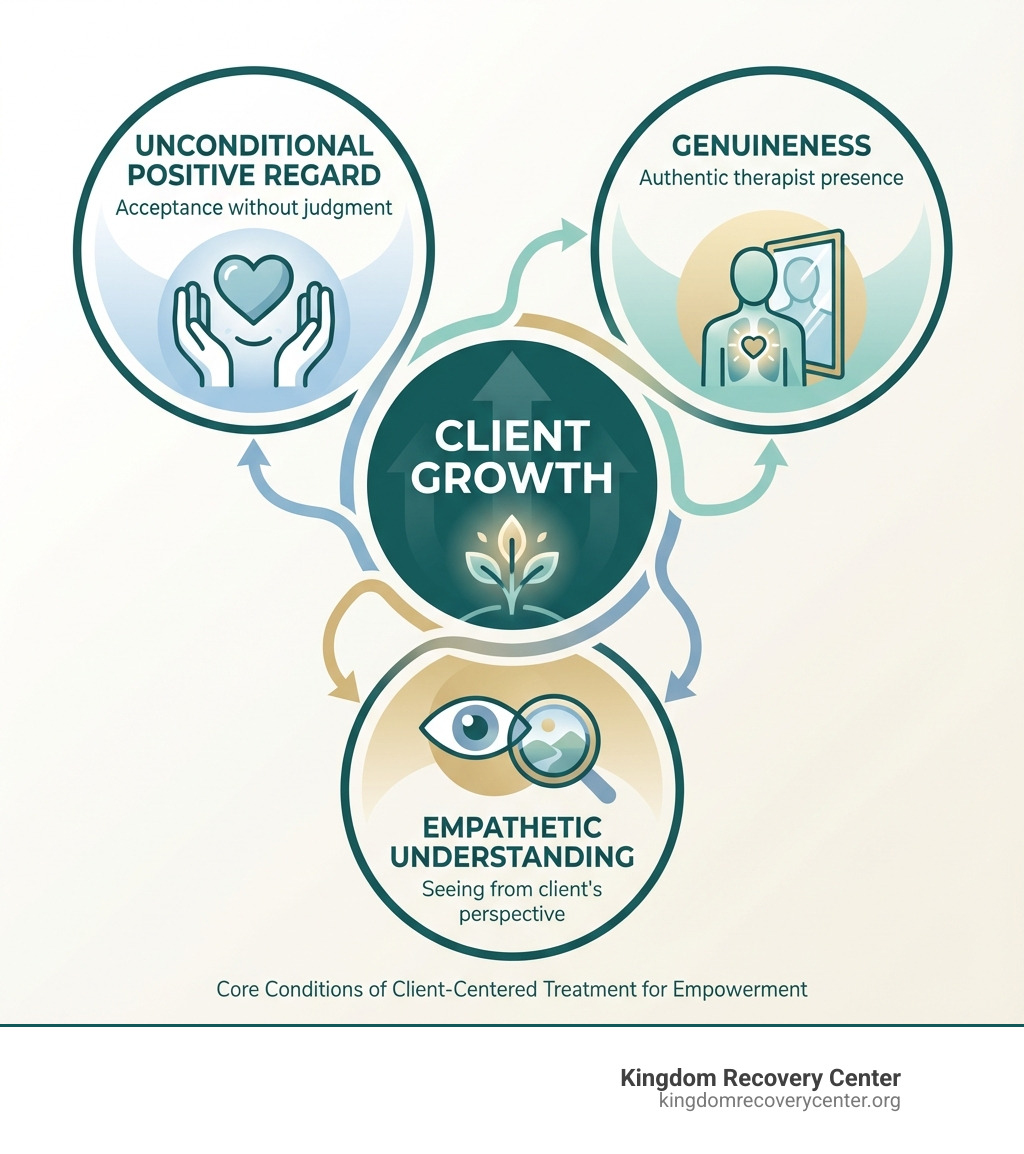
Client centered treatment is a non-directive form of talk therapy where you—not the therapist—lead the conversation and direct your own healing journey. Instead of a medical expert diagnosing and prescribing solutions, the therapist acts as a supportive guide who believes in your inherent capacity to find your own answers. This approach, also called person-centered or Rogerian therapy, is built on three essential qualities: unconditional positive regard (complete acceptance without judgment), genuineness (authentic, honest communication), and empathetic understanding (truly seeing the world from your perspective).
Key aspects of client-centered treatment:
- You are the expert on your own life and experiences
- The therapist facilitates self-findy rather than offering advice or interpretations
- The therapeutic relationship itself becomes the primary tool for healing
- Focus remains on the present moment rather than past events
- Your natural drive toward self-actualization guides the process
- The approach is non-judgmental and creates a safe space for honest exploration
At Kingdom Recovery Center, we’ve witnessed how client-centered treatment empowers individuals struggling with addiction, mental health challenges, and co-occurring disorders to reclaim their lives through compassionate, evidence-based care. Our Tennessee-based facility integrates this humanistic approach into comprehensive treatment programs that honor each person’s unique journey toward lasting recovery.
The Foundations of Client-Centered Therapy
The story of client-centered treatment begins with a visionary psychologist named Carl Rogers. In the 1940s, Rogers pioneered this approach, which marked a significant departure from the more traditional, authoritative therapeutic models of his time, such as psychoanalysis and behaviorism. He envisioned a therapy that respected the individual’s inner wisdom and drive for growth.
Rogers’ work is deeply rooted in humanistic psychology, a perspective that emphasizes human potential, free will, and the inherent goodness of people. Unlike medical models that often focus on diagnosing and treating pathology, Rogers rejected this “expert-patient” dynamic. Instead, he deliberately chose the term “client” over “patient” to underscore an equal partnership in the therapeutic relationship. This simple linguistic shift was profound, empowering individuals to take an active role in their healing process rather than passively receiving treatment.
At the heart of client-centered treatment is the belief in a fundamental human drive known as the self-actualization tendency. This is our innate desire to fulfill our potential, to grow, and to become the best versions of ourselves. Rogers believed that given the right environment, every individual possesses the capacity to overcome challenges and achieve personal growth. This perspective forms a crucial part of our philosophy at Kingdom Recovery Center, where we recognize and nurture this inherent drive in everyone we serve in Tennessee.
To learn more about how therapy plays a vital role in recovery, explore our insights on the role of therapy in recovery.

The Core Principles of Client-Centered Treatment
The principles of client-centered treatment are neatly simple yet incredibly powerful. They are founded on the belief that each person possesses an inherent capacity for growth and self-healing. We understand that you are the expert on your own life and experiences; no one knows your inner world better than you do.
This approach emphasizes a focus on the present moment, encouraging clients to explore their current thoughts, feelings, and experiences rather than dwelling exclusively on the past. While past events might inform who we are, the power to change and grow resides in the here and now.
Crucially, the therapeutic relationship itself is viewed as the primary agent of change. It’s not about the therapist having all the answers, but about creating a relationship built on trust, acceptance, and understanding. This unique connection provides a safe and nurturing space where clients can explore their true selves without fear of judgment. This idea was central to Rogers’ early work, as detailed in significant aspects of scientific research on client-centered therapy’s origins.
The Goal of Self-Actualization
In client-centered treatment, the ultimate goal is to facilitate self-actualization. This means helping you move towards fulfilling your unique potential and becoming the person you are truly meant to be. Rogers believed that people are continuously striving for a “good life,” which he defined not merely as the absence of problems, but as a process of growing, experiencing, and becoming.
A key concept here is the idea of congruence versus incongruence. Congruence occurs when your self-concept—how you see yourself—aligns with your actual experiences. Incongruence, on the other hand, is a mismatch between your self-perception and reality, which can lead to distress and anxiety. For example, a client may view themselves as uninteresting, despite others finding them engaging and vibrant. This discrepancy can lead to low self-esteem and internal conflict.
Through client-centered treatment, we aim to help you achieve greater congruence, leading to increased self-awareness and a deeper trust in your own experiences and feelings. This journey of self-findy empowers you to make choices that are authentic and aligned with your true self, fostering lasting personal growth and well-being.
The Three Pillars: A Therapist’s Role in Fostering Growth
In client-centered treatment, the therapist isn’t a director, but rather a facilitator. Their role is to create a nurturing, non-directive environment where you feel safe enough to explore your thoughts and feelings without fear. This involves more than just listening; it requires active engagement, profound respect, and unwavering support.
Therapists practicing this approach are skilled in active listening, paying careful and perceptive attention to everything you say, both verbally and non-verbally. They help you process your experiences by reflecting back what they hear and understand, allowing you to gain new perspectives on your own words. The therapist’s consistent non-judgmental support is the bedrock upon which genuine self-exploration and growth can occur.

1. Unconditional Positive Regard
Imagine having someone listen to you, truly listen, without a hint of judgment or evaluation, no matter what you share. That’s the essence of unconditional positive regard. It’s about total acceptance, valuing you as a human being just as you are, flaws and all.
In client-centered treatment, our therapists at Kingdom Recovery Center offer this unwavering acceptance, creating a psychological space where you feel safe to be completely yourself. This non-judgmental stance is crucial for fostering your self-worth and enabling you to explore difficult emotions or experiences without the fear of disapproval. When you experience this deep level of acceptance, it allows you to accept yourself more fully. Studies consistently show that when clients perceive unconditional positive regard from their therapists, they are significantly more likely to report achieving positive outcomes in therapy. This critical connection is supported by meta-analytic reviews such as the one on positive regard and psychotherapy outcome.
2. Genuineness (Congruence)
Genuineness, also known as congruence, means that your therapist is authentic, transparent, and real in their interactions with you. They don’t hide behind a professional facade; instead, they relate to you as another human being, comfortable in their own skin.
This authenticity builds a profound sense of trust. When a therapist is genuine, their words and actions align, creating a consistent and reliable presence. They might even model appropriate vulnerability, sharing their own feelings in a way that encourages you to be open as well. This open communication is a two-way street, fostering a deeper, more honest therapeutic relationship. When your therapist is truly themselves, it creates a powerful invitation for you to do the same.
3. Empathetic Understanding
Empathetic understanding is the therapist’s ability to accurately and sensitively grasp your world from your perspective. It’s about truly stepping into your shoes, seeing through your eyes, and feeling what you feel, then communicating that understanding back to you.
This isn’t about sympathy or pity; it’s about deep, active listening and reflecting your feelings and thoughts so clearly that you feel profoundly heard and understood. By acting as a mirror to your internal experience, the therapist helps you acknowledge and process your own emotions and thoughts more effectively. This process validates your experiences and helps you gain clarity, often leading to new insights. Research, such as the updated meta-analysis on therapist empathy and client outcome, consistently highlights the powerful role of empathy in promoting positive therapeutic results.
Effectiveness and Applications of Client-Centered Treatment
Client-centered treatment is a versatile approach that can be effectively applied in various therapeutic settings. We use its principles in individual therapy sessions, where the focus is entirely on your unique journey. It’s also highly beneficial in group therapy, where the shared experience of unconditional positive regard and empathetic understanding among members can be incredibly powerful. Furthermore, elements of this approach are integrated into family counseling, helping to foster understanding and open communication within family units.
Our array of therapies offered at Kingdom Recovery Center often incorporates these core client-centered principles to ensure a holistic and individualized approach to healing.
Conditions and Situations Where It Excels
Client-centered treatment excels in situations where individuals need to explore their feelings, build self-esteem, and develop a stronger sense of self. It’s particularly effective for:
- Depression and Anxiety: By providing a safe, non-judgmental space, clients can explore the roots of their distress, gain self-awareness, and develop internal resources to cope. Empathetic understanding, in particular, promotes positive outcomes for those experiencing depression and anxiety.
- Grief: Navigating loss is a deeply personal process. This approach allows individuals to process their grief at their own pace, without being rushed or told how they “should” feel.
- Trauma and PTSD: While not a trauma-specific modality, the safety and acceptance offered in client-centered treatment can be invaluable for individuals recovering from traumatic events. It creates an environment where they can gradually process their experiences without feeling re-traumatized. In fact, person-centered therapy may be comparable to evidence-based treatments for PTSD, with fewer dropouts. Trauma treatment research consistently shows lower dropout rates with person-centered therapy compared to other types of treatment.
- Substance Use Disorders: For individuals struggling with addiction, client-centered treatment helps foster self-awareness and intrinsic motivation for change. By valuing the client’s perspective and inherent capacity for growth, it empowers them to take ownership of their recovery journey. We integrate this approach into our comprehensive programs at Kingdom Recovery Center, including our specialized dual diagnosis treatment for those experiencing co-occurring mental health and substance use challenges in Tennessee.
- Stress Management: Learning to cope with life’s pressures often involves understanding one’s reactions and developing healthier responses. The self-exploratory nature of this therapy aids in this process.
- Relationship Issues: By improving self-awareness and communication skills within the therapeutic setting, clients often find they can apply these learnings to their interpersonal relationships.
Comparing Therapeutic Approaches
While client-centered treatment is uniquely powerful, it’s helpful to understand how it contrasts with other common therapeutic modalities. Let’s compare it to Cognitive Behavioral Therapy (CBT), another highly effective approach we use at Kingdom Recovery Center:
| Feature | Client-Centered Therapy | Cognitive Behavioral Therapy (CBT) |
|---|---|---|
| Therapist’s Role | Facilitator, non-directive, guide, empathetic listener | Directive, collaborative, expert in cognitive/behavioral techniques |
| Client’s Role | Leads the session, expert on their own experience | Active participant, learns and applies specific skills |
| Focus | Self-findy, personal growth, self-actualization, present moment | Identifying and changing unhelpful thoughts and behaviors |
| Techniques | Active listening, reflection, unconditional positive regard, genuineness, empathy | Cognitive restructuring, behavioral experiments, exposure therapy, skill-building |
| Primary Mechanism of Change | Therapeutic relationship, client’s inherent drive for growth | Learning new coping skills and modifying maladaptive patterns |
To dig deeper into other therapeutic approaches, you can explore our resources on CBT for mental health.
Research on Efficacy and Limitations
The effectiveness of client-centered treatment has been a subject of ongoing research, yielding compelling results.
- Lower Dropout Rates for PTSD: For individuals dealing with PTSD, person-centered therapy has shown comparable efficacy to other evidence-based treatments, often with the added benefit of fewer dropouts. This suggests that the supportive, non-judgmental environment may encourage greater client retention.
- Depression: A 2021 randomized, non-inferiority trial comparing person-centered therapy with CBT as a therapeutic intervention for depression found that person-centered therapy was not inferior to CBT at 6 months. This indicates it can be a highly effective option for many individuals struggling with depression.
- Older Adults: For adults with depression older than 50, non-directive counseling (a form of client-centered treatment) was found to be effective, with positive effects maintained for at least 6 months. This highlights its applicability across different age groups.
- Positive Outcomes: Studies have consistently found that when clients perceive unconditional positive regard from their therapists, they are more likely to report achieving positive outcomes. This underscores the power of the core conditions.
However, like any therapeutic approach, client-centered treatment also has its potential limitations and criticisms:
- Lack of Structure: Some clients, particularly those experiencing high levels of stress or anxiety, may find the non-directive nature and lack of explicit structure challenging. They might prefer more guidance or specific techniques.
- Severity of Conditions: For individuals with certain severe personality disorders or acute mental health crises, the non-directive nature may not provide sufficient immediate intervention or structure needed for stabilization. In such cases, a more directive approach or integrated treatment plan might be recommended.
- Vagueness: Critics have sometimes argued that the principles can be too vague or that the unique qualities of client-centered treatment are not effective, with its effective aspects being common to all good therapy.
Despite these points, the adaptability and client-empowering nature of client-centered treatment make it a valuable component of a comprehensive care strategy, especially when integrated into individualized treatment plans.
Frequently Asked Questions about Client-Centered Therapy
Is the therapist just a passive listener in this approach?
This is a common misconception! In client-centered treatment, the therapist is far from passive. While they don’t direct the conversation or offer advice, they are and actively engaged. They practice active listening, reflecting your words and feelings back to you, clarifying your statements, and creating a consistently supportive and non-judgmental environment. Their goal isn’t to solve your problems for you, but to facilitate your own process of self-findy and problem-solving. Think of them as a highly skilled mirror, helping you see and understand yourself more clearly.
How does client-centered therapy differ from other talk therapies?
The primary difference lies in its non-directive nature and the role assigned to the client. In many other talk therapies, the therapist might guide the session, interpret your experiences, or teach specific coping skills. In contrast, client-centered treatment positions you as the expert on your own life. The therapist refrains from diagnosing, judging, or providing direct solutions. Instead, the focus is heavily placed on the therapeutic relationship itself as a healing tool, built on the three core conditions of unconditional positive regard, genuineness, and empathetic understanding. It’s about empowering you to find your own answers, not receiving them from an external authority.
Who is a good candidate for client-centered therapy?
Client-centered treatment is an excellent fit for individuals who are:
- Motivated for Self-Exploration: Those who are ready and willing to dig into their inner world, thoughts, and feelings.
- Seeking to Improve Self-Esteem and Self-Trust: Individuals who want to build a stronger sense of self-worth and learn to trust their own decisions.
- Hesitant about More Structured or Authoritative Therapy Models: If you’ve felt uncomfortable with therapies that feel too prescriptive or where the therapist holds too much authority, this non-directive approach might resonate with you.
- Dealing with General Life Stressors: People facing anxiety, depression, grief, or relationship challenges can find immense benefit in a space where they are truly heard and accepted.
- Looking for Deeper Self-Awareness: If your goal is to understand yourself better and align your actions with your authentic self, this therapy can be profoundly transformative.
Begin Your Journey to Self-Findy
Client-centered treatment offers a powerful and deeply personal path toward healing and growth. It’s about open uping your own potential, recognizing the wisdom within you, and building a foundation for lasting, authentic change. We believe that everyone deserves a space where they can be truly seen, heard, and accepted without judgment.
At Kingdom Recovery Center, our commitment to individualized care means we integrate these profound principles into our evidence-based programs, ensuring that your journey to recovery is custom to your unique needs and strengths. If you’re ready to explore your inner resources and start on a path of self-findy and empowerment, we are here to support you.
Start your personalized recovery journey in Tennessee by exploring our options for drug and alcohol detox. Our team in Morristown, Knoxville, Johnson City, Hamblen County, and across East Tennessee is ready to partner with you.