
Depression Treatment in Knoxville, TN: What You Need to Know
Depression treatment in Knoxville TN is more accessible than many people realize — and finding the right help can change everything.
Here are the most common options available in the Knoxville area:
| Treatment Option | Best For |
|---|---|
| Cognitive Behavioral Therapy (CBT/DBT) | Mild to moderate depression, building coping skills |
| Dual Diagnosis Programs | Depression + substance use disorders |
| Partial Hospitalization (PHP) | Intensive structured support without inpatient stay |
| Specialized Programs | Postpartum, teens, veterans |
| Holistic Therapies | Whole-person wellness, treatment-resistant cases |
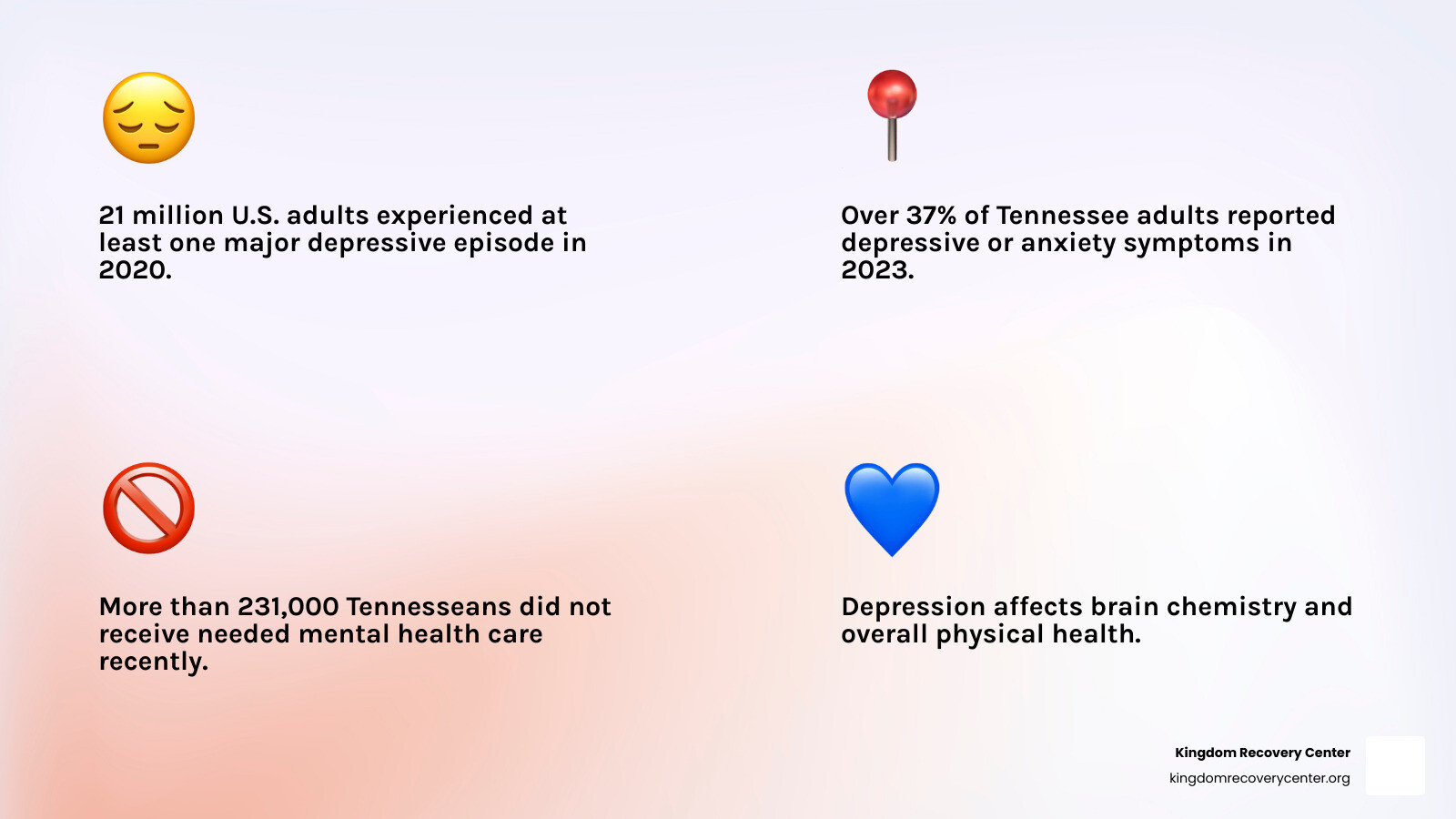
Depression is one of the most common — and most treatable — mental health conditions in the country. About 21 million U.S. adults had at least one major depressive episode in 2020. In Tennessee, that burden is felt deeply: over 37% of Tennessee adults reported depressive or anxiety symptoms as recently as 2023, and more than 231,000 Tennesseans didn’t get the mental health care they needed.
The good news? Recovery is possible. The hard part is often just knowing where to start.
At Kingdom Recovery Center, based in Morristown, TN, we’ve helped people across East Tennessee — including those seeking depression treatment in Knoxville TN — find their footing through compassionate, evidence-based care tailored to each person’s needs. Whether you’re dealing with depression alone or alongside addiction or trauma, we’re here to walk that road with you.
Symptoms and Prevalence of Depression in East Tennessee
As we move through April 2026, the landscape of mental health in East Tennessee continues to evolve. While Knoxville is a vibrant place to live, many of our neighbors struggle in silence. Depression isn’t just “feeling blue” — it is a complex medical condition that affects the brain’s chemistry and a person’s entire physical being.
Understanding the Symptoms
Major Depressive Disorder (MDD) manifests differently for everyone. Some common signs we see in our community include:
- Persistent Sadness or Hopelessness: A heavy feeling that doesn’t lift, regardless of circumstances.
- Physical Changes: Significant weight loss or gain, or sleeping too much (hypersomnia) or too little (insomnia).
- Loss of Interest: No longer finding joy in hobbies, social gatherings, or activities once loved.
- Cognitive Struggles: Difficulty focusing, making decisions, or remembering details.
- Suicidal Ideation: Thoughts of self-harm or that the world would be better off without you.
Postpartum Depression (PPD)
In Tennessee, PPD is a significant concern. Statistics show that roughly 1 in 8 women report symptoms of postpartum depression following a live birth. Unlike the “baby blues,” which typically fade after two weeks, PPD can emerge anytime during the first year of a child’s life. It can interfere with bonding and requires specialized Mental Health Treatment Tennessee Guide resources to ensure both parent and child thrive.
Prevalence and Impact
The numbers are sobering. About 15.08% of American youth experienced a major depressive episode in the past year, and the highest rates among adults are found in the 18-25 age group (17%). In East Tennessee, the impact is compounded by co-occurring disorders. Roughly 20.4 million American adults struggle with both a substance use disorder and a mental health condition simultaneously. When these two collide, the need for integrated depression treatment in Knoxville TN becomes even more critical.
5 Best Options for Depression Treatment in Knoxville TN

When you are looking for the best depression treatment in Knoxville TN, you aren’t just looking for a doctor; you’re looking for a path back to yourself. We believe the most effective treatments are those that treat the person, not just the diagnosis.
The “best” treatment is never a one-size-fits-all solution. For some, it might be a weekly therapy session. For others, it might require a more intensive, structured environment. At Kingdom Recovery Center, we focus on evidence-based methods that have been proven to help people achieve long-term remission. We integrate clinical excellence with a warm, supportive atmosphere to ensure you never feel like just a number on a chart.
The Role Of Cbt In Anxiety And Depression Symptoms is a cornerstone of modern recovery, but it is just one piece of the puzzle. Let’s dive into the five most effective treatment avenues available in our region.
1. Cognitive Behavioral Therapy (CBT) and DBT
Cognitive Behavioral Therapy (CBT) is often considered the “gold standard” for depression. It works on a simple but powerful premise: our thoughts, feelings, and behaviors are all interconnected. By identifying and challenging negative thought patterns (like “I’m a failure” or “Things will never get better”), we can actually change how we feel and act.
Dialectical Behavior Therapy (DBT) is a specialized form of CBT. While CBT focuses on logic and thought-changing, DBT adds a layer of emotional regulation and mindfulness. It is incredibly effective for people who experience intense emotions or have a history of trauma.
- Individual Therapy: One-on-one sessions allow for deep dives into personal history and trauma-informed care.
- Coping Skills: You learn practical tools to handle stress in real-time, preventing a bad day from turning into a depressive episode.
- Identifying Triggers: We help you map out the “why” behind your symptoms so you can navigate life with more confidence.
2. Dual Diagnosis Treatment
Many people who come to us for depression treatment in Knoxville TN are also struggling with alcohol or drug use. Often, the substance use started as a way to self-medicate the pain of depression. Unfortunately, this creates a vicious cycle where the substance actually makes the depression worse over time.
Dual Diagnosis Treatment addresses both issues at the exact same time. We don’t believe in treating addiction in one building and depression in another. Integrated care ensures that:
- Root Causes are Addressed: We look at the underlying trauma or biological factors driving both conditions.
- Comprehensive Recovery: By stabilizing the mood, the urge to use substances often decreases.
- Coordinated Staff: Our clinical team works together to ensure your medication and therapy are aligned for both mental health and sobriety.
3. Partial Hospitalization Programs (PHP)
Sometimes, traditional once-a-week therapy isn’t enough, but a full-time inpatient hospital stay feels like too much. This is where a Partial Hospitalization Program (PHP) fits in. It is a structured day treatment program that provides intensive clinical support while allowing you to return home (or to a supportive living environment) at night.
PHP typically involves:
- Intensive Clinical Support: Several hours of therapy, group work, and medical check-ins every day.
- Medical Supervision: Close monitoring of symptoms and medication adjustments by professionals.
- Community Building: You spend your day with others who understand exactly what you’re going through, reducing the isolation that depression often causes.
- Transitioning Care: PHP is an excellent “step-down” for those leaving a residential or inpatient facility who aren’t quite ready to be fully on their own yet.
4. Specialized Programs for Depression Treatment in Knoxville TN
Depression doesn’t look the same for a 16-year-old as it does for a 45-year-old veteran or a new mother. That’s why specialized programs are so vital.
- Postpartum Care: Focusing on the unique hormonal and lifestyle shifts of new parenthood, helping parents bond with their babies while regaining their own health.
- Veteran Support: Addressing the specific traumas and transition challenges faced by those who have served.
- Teen Programs: Adolescence is a time of massive brain development. Specialized teen care focuses on social dynamics, school stress, and family integration.
If you are wondering if a higher level of care is necessary, you can explore 5 Ways To Know If Inpatient Depression Treatment In Knoxville Is Right For You to better understand your options.
5. Holistic and Experiential Therapies
We believe that healing happens in the body just as much as it happens in the mind. Traditional “talk therapy” is vital, but sometimes you need to get moving to break the stagnation of depression. Holistic and experiential therapies are designed to treat the whole person.
- Mindfulness and Yoga: Helping you reconnect with your body and stay grounded in the present moment.
- Art Therapy: Expressing emotions that are too difficult to put into words.
- Outdoor Activities: Taking advantage of the beautiful East Tennessee landscape to boost Vitamin D and endorphins.
- Equine-Assisted Therapy: Working with horses to build trust, empathy, and emotional regulation.
- Wellness-Focused Recovery: Integrating nutrition and physical health into your mental health plan.
Comparing Levels of Clinical Support
Choosing the right level of care can feel overwhelming. Do you need an hour a week or thirty? The answer depends on the severity of your symptoms and your current support system at home.
| Feature | PHP (Partial Hospitalization) | IOP (Intensive Outpatient) | Traditional Outpatient |
|---|---|---|---|
| Hours per week | 20-30+ hours | 9-15 hours | 1-2 hours |
| Clinical Intensity | Very High | Moderate to High | Low to Moderate |
| Flexibility | Low (Daytime commitment) | High (Often evening options) | Very High |
| Medical Supervision | Daily/Frequent | Weekly/As needed | Minimal |
| Best For | Severe symptoms/Crisis | Moderate symptoms | Maintenance/Mild cases |
Finding the right fit at a Knoxville recovery center means being honest about your needs. If you find yourself unable to go to work or care for your family, a PHP or IOP might be the best way to jumpstart your recovery.
Navigating Insurance and Levels of Care for Depression Treatment in Knoxville TN
One of the biggest barriers to seeking depression treatment in Knoxville TN is the fear of the cost. However, thanks to the Affordable Care Act (ACA), mental health and substance use services are considered “essential health benefits.” This means most insurance plans are required to provide coverage.
Insurance Providers
We frequently work with major insurance carriers to help our clients minimize out-of-pocket costs. Common providers include:
- BlueCross BlueShield (BCBS)
- Aetna
- Cigna
- Medicare
- UnitedHealthcare (UHC)
It’s also important to know your rights under the Family and Medical Leave Act (FMLA). If you are eligible, FMLA can provide up to 12 weeks of unpaid, job-protected leave for serious health conditions, including depression treatment. This allows you to focus entirely on your recovery without the fear of losing your career.
Levels of Clinical Support at Kingdom Recovery Center
We offer a spectrum of care to meet you where you are:
- Inpatient Care: For those in immediate crisis or needing 24/7 stabilization.
- Partial Hospitalization (PHP): Intensive daily therapy while living at home or in sober living.
- Intensive Outpatient (IOP): Flexible scheduling (often 3 days a week) that allows you to maintain work or school responsibilities.
- Residential Treatment: A long-term, immersive environment for deep healing and skill-building.
How to Start Depression Treatment in Knoxville TN
Getting started is often the hardest part, but we’ve streamlined our process to make it as stress-free as possible:
- Initial Assessment: A confidential conversation to understand what you’re going through.
- Clinical Evaluation: A thorough review by our medical and mental health professionals.
- Insurance Verification: Our team handles the phone calls to your insurance company for you.
- Personalized Planning: We create a roadmap for your recovery based on your specific goals.
You don’t have to figure this out alone. You can Start your journey at our Knoxville center today by reaching out for a confidential chat.
Frequently Asked Questions about Depression Treatment
Does insurance cover intensive outpatient programs for depression?
Yes! Most major insurance plans, including BCBS, Aetna, and Cigna, cover Intensive Outpatient Programs (IOP). Because mental health is an essential benefit, these programs are often covered similarly to physical medical procedures. Our admissions team can verify your specific benefits in minutes.
What is the difference between “baby blues” and postpartum depression?
The “baby blues” affect up to 80% of new mothers and usually involve crying spells and anxiety that disappear within two weeks after birth. Postpartum depression is much more severe, lasts longer, and can include thoughts of self-harm, inability to care for the baby, and intense hopelessness. PPD requires professional intervention.
How do I know if I need PHP or IOP care?
If you are struggling to function in your daily life—meaning you can’t get out of bed, can’t work, or feel unsafe—PHP is likely the better choice. If you are still able to manage some daily tasks but find your symptoms are getting worse and you need more support than a weekly therapy session, IOP offers the perfect balance of intensity and flexibility.
Conclusion
Depression can make your world feel very small and very dark, but it doesn’t have to stay that way. Long-term remission is not just a dream; it is a reality for thousands of people in East Tennessee who have taken the step to seek help. Whether it’s through the structured support of a PHP, the specialized care of a dual diagnosis program, or the healing power of holistic therapies, the path forward is waiting for you.
At Kingdom Recovery Center, we are more than just a facility; we are a community dedicated to lasting change. We believe in your ability to heal, and we have the tools to help you get there. If you or a loved one are ready to explore depression treatment in Knoxville TN, we are ready to listen.
Contact us for a consultation and let’s take that first step toward a brighter future together.